A herbicide can leave a treatment area while it is being applied, or move later with water. Those are different routes, and an investigation focused on only one can leave important questions unanswered.
For people living near forestry operations in Lassen and Plumas counties, the distinction changes what evidence matters. Wind and application conditions help explain spray drift. Rainfall, drainage, and soil conditions help explain movement with water. A sample collected from a stream may establish a detection without, by itself, identifying which route brought the chemical there.
Using the right words is therefore more than a technical preference. It helps determine whether a conclusion actually answers the question the community is asking.
Spray drift begins with airborne droplets or particles
The Environmental Protection Agency describes spray drift as pesticide droplets or dust moving through the air during or soon after application to a location where they were not intended to go. Ground equipment as well as aircraft can produce drift.
The method of application matters, but it is not a finding by itself. Seeing a helicopter does not establish that a particular offsite deposit came from it. The absence of a helicopter does not establish that no airborne movement occurred. Relevant observations include the actual application time, equipment, weather, and spatial pattern of deposits.
For example, a hypothetical sample taken beside a treatment boundary immediately after application answers a different question from a sample taken several months later at a downstream pond. The first may be more closely tied in time to the application event. The second may reflect a longer and more complicated history. Neither should be described more conclusively than its supporting evidence allows.
Vapor movement is another airborne process
The National Pesticide Information Center distinguishes particle drift from vapor drift. In vapor drift, material evaporates and moves through the air after application. Whether this is plausible depends on the chemical and conditions; the possibility should not be assigned equally to every herbicide.
NPIC’s explanation of vapor pressure describes a property relevant to that potential. Temperature and product characteristics can affect volatilization. This is why the name of the active ingredient and formulation matter more than a generic statement that “pesticides drift.”
A complete account should identify which airborne process is being discussed. Evidence about droplets during spraying is not necessarily evidence about vapor movement afterward. Conversely, merely listing several possible processes does not establish that all of them occurred at a particular location.

Runoff follows moving water
NPIC’s guidance on pesticides and water explains how rainfall can wash pesticide material into surface water and how environmental conditions and chemical properties affect the route. The relevant setting includes both the treated ground and the connections carrying water away from it.
Surface runoff is movement across the ground. Leaching is movement downward through soil, a distinction also addressed in California Water Boards pesticide-management guidance. They can require different observations and sampling locations.
That distinction is particularly useful when evaluating a claim about a stream, spring, or well. A visible drainage channel may help identify a surface connection. It does not map the whole groundwater system. The lack of a visible channel does not, by itself, close the subsurface question.
For reporting purposes, “offsite movement” is the broader question. Drift, runoff, and leaching describe mechanisms that may contribute to it. A narrow conclusion about one mechanism should remain narrow unless the others were also examined.
One forestry study found different peak timing in different years
A 2015 study by Brenda Baillie and colleagues followed operational herbicide use in a 12.5-hectare radiata-pine catchment in New Zealand. The research examined hexazinone and terbuthylazine over two application years.
In the first year, the highest concentrations occurred on the application day, with drift identified as the principal pathway. In the second, the highest concentrations were associated with rainfall seven days after application. The same research setting therefore produced different timing for the largest measured events.
This was not a study of Lassen or Plumas, and its findings should not be converted into a prediction of local concentrations. Its relevance is methodological: monitoring only the application day could describe one year better than the other. Sampling only after rain could also miss important application-day movement.
The study provides a concrete reason to align monitoring with the possible routes instead of choosing one convenient day and treating it as a complete history.
The routes can happen in sequence
Airborne and waterborne transport are not always competing explanations. Material can be deposited on a surface and later be carried away with water.
USGS research on atmospheric deposition and runoff in California’s San Joaquin Valley examined pesticides in air, precipitation, and runoff over several years. The study’s agricultural and urban settings differ from mountain forestry, but its attention to deposition and subsequent transport illustrates why the environmental history can include more than one step.
A stream sample collected after a storm might therefore raise several possibilities. Material could have traveled from treated ground, from a location where it had previously been deposited, or through another connected source. Determining which explanation fits requires more than noticing that rain occurred.
This does not make attribution impossible. It makes the surrounding evidence important: what was used, when it was used, where water moved, what was detected at other locations, and how the concentration changed over time.
A map is a starting point, not a complete transport study
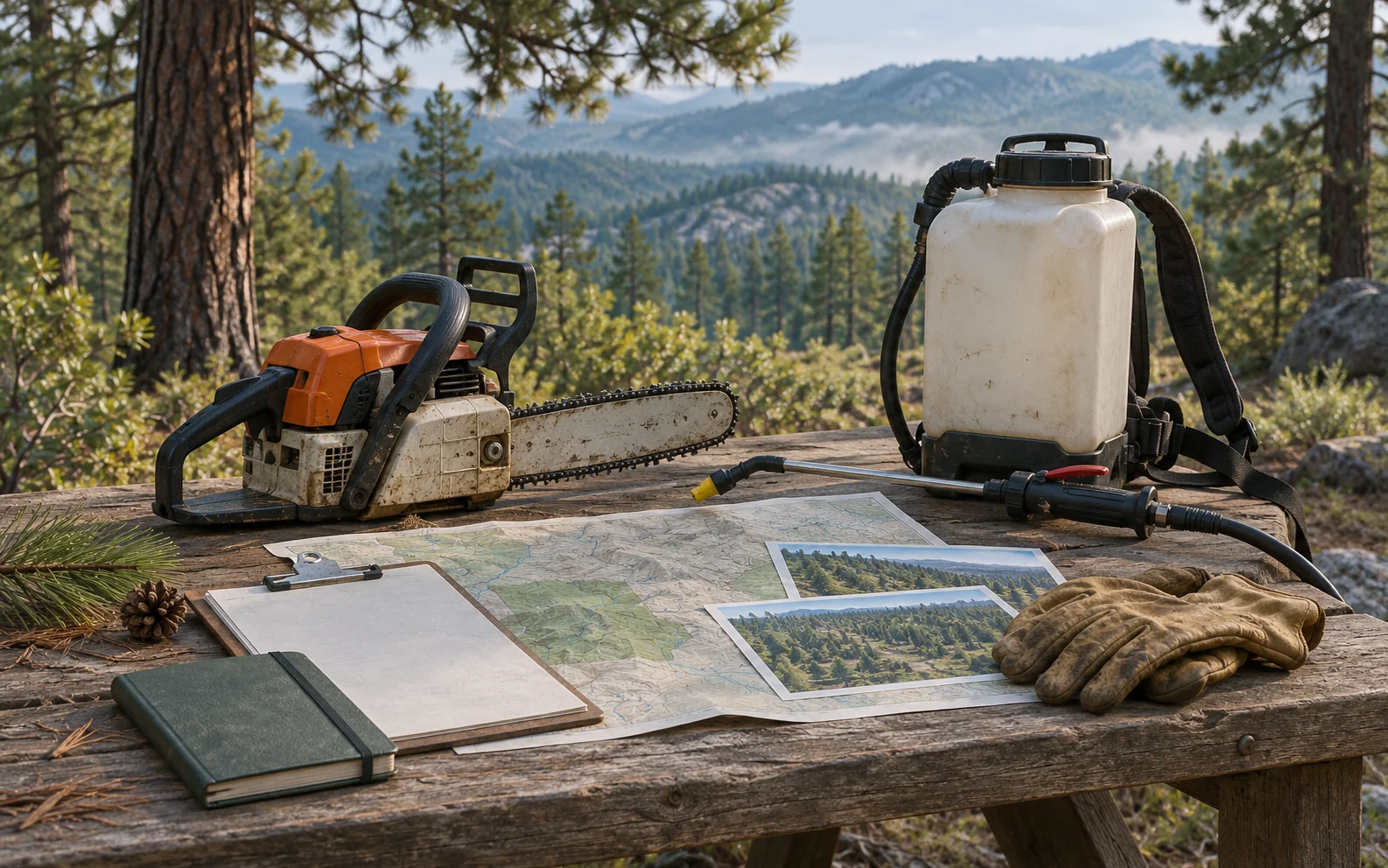
A treatment map can show that a potential source exists nearby. Topography can suggest plausible connections. Neither proves that a specific substance traveled along a particular route on a particular day.
Consider a hypothetical treated slope above a stream with two tributaries. A downstream detection establishes that the sampled water contained the reported chemical. Samples from the tributaries, taken under comparable conditions, could help distinguish the contributing areas. If only the final downstream point is sampled, the evidence may be less able to separate them.
Similarly, a concentration measured after the water has passed through several inputs is not automatically the concentration at the original point of entry. Without the relevant flow and timing information, working backward to a precise release amount would be speculative.
These examples explain limits in the evidence; they do not excuse leaving obvious pathways unexamined. A strong assessment identifies the gaps and explains which additional observations would reduce them.
Sampling quality and timing answer different questions
A technically valid laboratory analysis can still be part of a poorly timed monitoring program. Reliable measurement of a late sample does not reconstruct an earlier peak that was never sampled.
USGS field quality-control guidance describes tools for evaluating the sampling process itself. Blank samples help detect contamination introduced during collection and handling. Replicates help assess variability. These checks address the reliability of measurements, while the selection of locations and dates determines which environmental events those measurements can describe.
Both elements are needed. A comparison between locations is stronger when collection methods are consistent. A comparison between seasons needs attention to differences in flow and weather. If the analytical method or reporting limit changes, that change also belongs in the interpretation.
A nondetection should be reported with its analytical limit and date. It does not mean that the chemical was absent at every earlier time. A detection should retain its units and sample type. It should not be expanded into an unsupported estimate of what someone drank or what an entire watershed contained.
| Possible route | Relevant evidence |
|---|---|
| Spray drift | Application timing and method, weather, and the pattern of off-target deposits. |
| Vapor movement | The chemical and formulation, volatility, temperature, and timing after application. |
| Surface runoff | Rain or snowmelt timing, connected drainage, flow conditions, and spatial sampling. |
| Leaching | Soil and groundwater conditions, chemical mobility, and samples appropriate to the subsurface question. |
Conclusions should match the work performed
If an assessment examined application-day drift, its conclusion should say what it found about that process. A statement that drift was not established should not silently become a statement that all offsite movement was ruled out. The reverse is equally important: a later detection does not automatically prove unlawful drift during spraying.
For Lassen and Plumas, clear reporting should identify the route being evaluated, the observations supporting the conclusion, and what remains unresolved. That makes disagreements more concrete. Readers can see whether the dispute concerns the sampling result, the proposed source, the transport pathway, or an interpretation that goes beyond the measurements.
The distinction is simple, but consequential: finding a chemical, explaining how it arrived, and determining responsibility are related tasks. They are not the same task.
Read next: Hexazinone: mobility, field studies, and what water tests show.