
Table of Contents
The Illusion of Community: How the Lassen Fire Safe Council Misleads the Public
All information in this report was compiled from publicly available sources found on the internet. Despite receiving millions of dollars in public funding, the Lassen Fire Safe Council—under the leadership of Ruth Morentz and Cade Mohler—has refused to disclose any documents or records in response to California Public Records Act (CPRA) requests.
The the Lassen Fire Safe Council (LFSC) promotes itself as a grassroots, fire-prevention nonprofit working in the public interest. Its announcements are filled with cheerful language about community support, donations to local fire departments, and volunteer collaboration. But beneath the polished surface lies a different reality—one where public image is carefully managed to conceal the the Lassen Fire Safe Council’s deeper alignment with industrial logging, herbicide use, and biomass extraction.
I. The Public Relations Mask
In a recent post, the Lassen Fire Safe Council proudly declared the second year of its “Community Fund,” highlighting token donations such as:
- $2,000 to each of 15 local fire departments
- $500 gift cards to 13 Firewise communities
- Distribution of Firewise-branded materials, including vinyl banners, pop-up signage, and printed event logos, along with chairs and pop-up tents
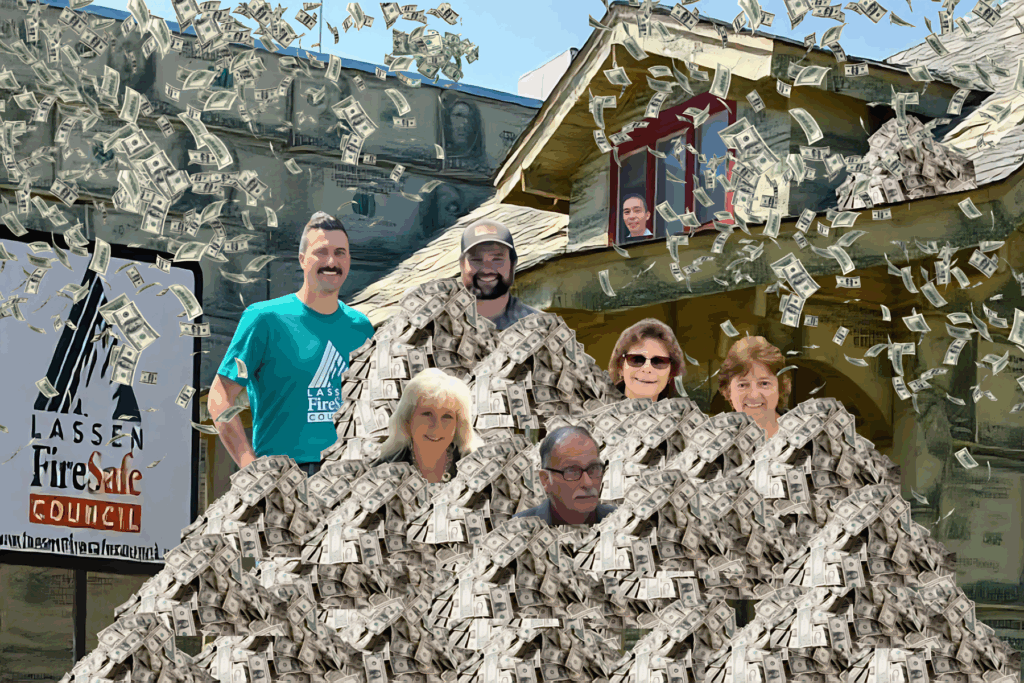
This amounts to roughly $43,500, a small fraction of the multi-million dollar grants the Lassen Fire Safe Council controls through state and federal wildfire recovery funds, including the PG&E Dixie Fire Settlement. The tone of the announcement is strategic—intended to evoke gratitude, unity, and trust. It is a textbook example of “community capture”: small, visible acts of generosity used to distract from large, opaque operations that may undermine long-term public health and environmental integrity.
II. The Real Purpose: Timber, Herbicides, and Biomass
Behind closed doors and buried in grant documentation, the Lassen Fire Safe Council’s real focus emerges:
- Coordinating large-scale herbicide applications across thousands of acres with no environmental monitoring
- Contracting with industrial timber companies like W. M. Beaty & Associates to carry out “fuel reduction” treatments that prioritize tree planting, logging, and biomass production
- Using nonprofit status to qualify for public funds while operating with minimal transparency, and refusing to release any documents in response to California Public Records Act (CPRA) requests
The same board members who cheerlead the Community Fund also sit on committees tied to commercial forestry and state grant coordination. The lines between public service and private industry have all but vanished.
III. The People Behind the Curtain
the Lassen Fire Safe Council’s Community Fund Committee includes:
- Lawrence Crabtree, former U.S. Forest Service supervisor with deep ties to the timber industry
- Jonathon Sims, a volunteer firefighter whose role is repeatedly invoked to create the illusion of grassroots alignment
- Deb Bumpus, former Lassen-Modoc CAL FIRE Chief, now advising a nonprofit that routinely avoids CEQA review for its herbicide projects
- Kam Vento, whose affiliations have helped secure and direct public funds to industry-aligned operations
These figures are not community representatives in the traditional sense. They are insiders—positioned to maintain control over funding pipelines while masking extraction-based activities as “fire prevention.”
IV. Strategic Manipulation of Language and Symbols
Firewise (officially Firewise USA) is a program run by the National Fire Protection Association (NFPA) that encourages communities in wildfire-prone areas to take collective action to reduce risk—such as removing flammable vegetation, improving defensible space, and preparing evacuation plans. Firewise Communities can receive recognition and use the label to promote fire safety.
However, in regions like Lassen County, the Firewise label is often co-opted by organizations like the Lassen Fire Safe Council to project a grassroots image. In reality, some Firewise “leaders” also hold roles on the Lassen Fire Safe Council’s finance and project oversight committees, such as the Community Fund Committee. This dual involvement allows the Lassen Fire Safe Council to present its programs as locally driven, while centralizing control of grant decisions and project execution within a small, internally aligned group. This creates a closed feedback loop where Firewise communities are presented as bottom-up participants, when in fact they are often conduits for top-down industry-aligned funding and decision-making.
the Lassen Fire Safe Council’s communications use classic nonprofit framing:
- “Excited to announce…”
- “Supporting community events…”
- “We can’t wait to share…”
But these announcements often lack specifics, environmental data, or independent review. By supplying tents and chairs to Firewise groups and issuing gift cards, the Lassen Fire Safe Council builds a loyal base of community partners who then feel indebted or included, making them less likely to question herbicide use or industrial motives.
The tactic is psychological: low-cost rewards create disproportionate trust, which then shields the Lassen Fire Safe Council’s far more expensive and risky operations from scrutiny.
V. The Numbers Don’t Lie
the Lassen Fire Safe Council also promotes isolated acts of support for educational institutions to further its image as a public-serving nonprofit. In July 2025, it announced a $10,000 scholarship partnership with Lassen College Foundation for students in the Forestry and Fire Technology programs (https://susanvillestuff.com/fire-safe-council-invests-in-future-firefighters-with-10k-in-lcc-scholarships/). While framed as an investment in “sustainability” and “environmental stewardship,” this gesture serves primarily as a public relations tool.
The recipients of the scholarship will likely enter into the same professional systems—forestry, firefighting, and land management—that the Lassen Fire Safe Council heavily influences through its industry contracts. Such initiatives further blur the line between genuine public service and calculated industry-aligned promotion.
While the announcement emphasizes $2,000 and $500 grants, public records and state databases reveal that the Lassen Fire Safe Council manages millions of dollars in state fire recovery grants—often for projects involving:
- Large scale herbicide spraying without monitoring or testing
- Monoculture industrial tree plantations, which have been shown to increase fire risk and insurance costs for rural communities (https://protectlassen.org/home-insurance-is-rising-in-lassen-county/)
- Biomass extraction under CEQA exemptions
In contrast, the funds returned to the community—about $43,500 this cycle—represent less than 1% of the Lassen Fire Safe Council’s total financial footprint. This is not fire prevention. It’s public relations.
VI. Additional Evidence from the Lassen Fire Safe Council’s Own Website
the Lassen Fire Safe Council’s own site reveals a consistent pattern of channeling millions in public funds toward industry-driven projects while allocating token support to communities:
- CAL FIRE grants include a $2.99 million project for North Susanville and multi-million-dollar projects in Shingletown, Dyer Mountain, and Whitmore.
- the Lassen Fire Safe Council solicits bids from licensed timber operators to clear land, skid trees, and haul biomass to facilities like Honey Lake Power.
- Completed herbicide applications, biomass clearing, and scheduled monoculture replanting are confirmed in their February 2025 project update.
the Lassen Fire Safe Council’s partnerships include W. M. Beaty & Associates, Sierra Pacific Industries, Collins Company, and Honey Lake Valley RCD—entities with commercial timber and biomass interests. Leadership ties to these same industries raise further questions about whose interests are truly being served.
Public messaging remains vague and symbolic, with little mention of environmental impact data, herbicide use disclosure, or CEQA/NEPA compliance. CPRA records confirm delays, denials, or obstruction in providing this data.
VII. Federal Awards Add to the Funding Stream
the Lassen Fire Safe Council’s access to public funds extends beyond state programs into federal grants. According to the HigherGov database:
- In 2017, the Lassen Fire Safe Council received a $25,000 grant (F17AC00623) from the U.S. Fish & Wildlife Service for the Little Valley Forest and Watershed Restoration Project in Lassen County.
- In 2024, it received $297,400 (24SA11051100020) from the U.S. Forest Service Region 5 under a Forest Service Assistance Grant, likely for fuels reduction or habitat treatment efforts.
Though relatively modest compared to state-level funds, these federal awards further illustrate how the Lassen Fire Safe Council capitalizes on its nonprofit status to serve as a conduit for public dollars—often without transparent reporting, environmental safeguards, or meaningful community oversight. The combined state and federal funding streams bolster the Lassen Fire Safe Council’s ability to carry out herbicide, thinning, and biomass operations with minimal scrutiny.
VIII. Massive State and Federal Funding Contradicts Public Image
A full accounting of the Lassen Fire Safe Council’s public funding exposes the wide gap between their small-scale community gestures and the industrial scope of their operations. According to HigherGov and state contract records:
State & Local CAL FIRE Grants (Over $21.7 Million)
| Description | Award Value | Start Date |
|---|---|---|
| 23–24 WP Grant 5TR23104 | $3.0 million | 12/04/2024 |
| 23–24 WP Grant 5TR23103 | $3.0 million | 12/04/2024 |
| 23–24 FH Grant | $6.5 million | 11/27/2024 |
| CCI Grant 5GA21112 | $200,000 | 05/11/2022 |
| GF Grant 5GA20110 | $9.0 million | 11/09/2021 |
Federal Grants to the Lassen Fire Safe Council (Over $4.3 Million)
| Award ID | Program Description | Amount | Awarding Agency |
|---|---|---|---|
| 22PA1105060008 | Thompson Peak data collection | $82,800 | USFS Pacific Southwest Region |
| 24SA11051100020 | Cradle Valley Site Prep | $297,400 | USFS Pacific Southwest Region |
| F17AC00623 | Little Valley Watershed Restoration | $25,000 | USFWS Headquarters |
| 23SA11051100026 | Cradle Valley biomass removal | $2.6 million | USFS Pacific Southwest Region |
| 22SA11051100018 | Protect eastside communities | $889,400 | USFS Pacific Southwest Region |
Subawards via California Fire Safe Council (Over $1.4 Million)
| Subaward ID | Summary & Description | Amount | Year |
|---|---|---|---|
| 54842 | 158-acre treatment for invasive juniper | $113,500 | 2017 |
| 17USFS-WUI57092 | Biomass removal coordination w/ SPI, WM Beaty | $260,900 | 2016 |
| 15USFS-SFA37762 | Biomass thinning on 445 acres | $200,000 | 2016 |
| 13USFS-SFA0026 | Milford community fire threat | $200,000 | 2013 |
| 13USFS-WUI0210 | Biomass removal on 900 acres | $255,000 | 2013 |
| 12USFS-WUI0204 | 600-acre Clear Creek treatment | $156,400 | 2012 |
Combined, these awards show the Lassen Fire Safe Council is not a small nonprofit simply “helping communities.” the Lassen Fire Safe Council is a major public grant contractor orchestrating biomass extraction, mechanical thinning, and herbicide-based land conversions across vast landscapes. All while giving the public the impression that it operates at the scale of tent giveaways and $2,000 donations.
For those who want to see the scale of the Lassen Fire Safe Council’s financial entanglements firsthand, visit the federal and state grant tracking database:
https://www.highergov.com/awardee/california-fire-safe-council-inc-12830033/
Conclusion: The Need for Real Transparency
The the Lassen Fire Safe Council is not a neutral, community-driven nonprofit. the Lassen Fire Safe Council is an industrially embedded project implementer that uses the imagery of fire prevention and community aid to protect its true mission: delivering large-scale, grant-funded treatments for private timber and biomass contractors.
If the Lassen Fire Safe Council wishes to be seen as legitimate, it must:
- Publicly disclose all herbicide products, locations, and maps
- Comply with CEQA and NEPA for its projects
- End its obstruction of CPRA requests
Until then, the community should see the Lassen Fire Safe Council’s gift cards and tents for what they are: camouflage.