
Why Your Home Insurance Keeps Getting More Expensive: The Hidden Connection Between Industrial Logging and California’s Fire Crisis
The Big Picture
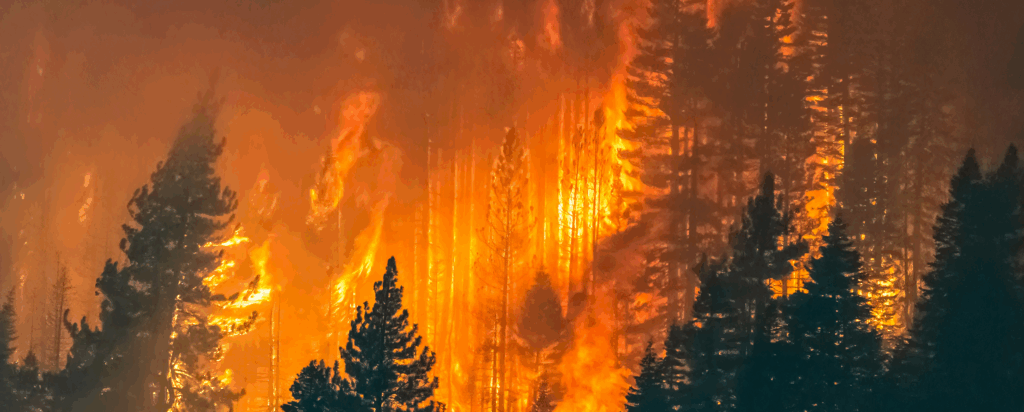
If you live in rural California, you’ve probably noticed two things: your home insurance is either ridiculously expensive or your company dropped you entirely, and wildfires seem to be getting worse every year. What you might not realize is that these problems are connected—and industrial timber companies might be making both worse.
Here in Lassen County, a complex web of public agencies and private contractors is spending millions of taxpayer dollars on “fire prevention” projects that may actually be increasing fire risk. Meanwhile, the same industrial forestry practices that create fire-prone landscapes are consuming massive amounts of water in an already drought-stressed region.
Let’s dig into how this system really works and why it matters for anyone trying to live, work, or own property in fire country.
Who’s Really Running the Show?
The official story sounds straightforward: Cal Fire gives grants to fight wildfires, local agencies implement projects, everyone’s safer. The reality is messier.
Here’s how the money actually flows: Sometimes Cal Fire provides grants to the Honey Lake Resource Conservation District (HLVRCD), which acts as the lead agency under California’s environmental laws. HLVRCD then passes that funding to the Lassen Fire Safe Council (LFSC), which hires subcontractors to do the actual work.
But here’s the kicker: sometimes Cal Fire just cuts out the middleman and gives grants directly to the timber companies. W.M. Beaty & Associates has received millions in direct Cal Fire funding over the years.
This might sound bureaucratic but harmless—until you realize who those subcontractors often are. Sierra Pacific Industries (SPI) and W.M. Beaty & Associates are two of the biggest players in the region. W.M. Beaty manages timberlands across multiple counties including Lassen, Plumas, Modoc, Shasta, and Siskiyou. These aren’t small local contractors—they’re industrial timber operations managing hundreds of thousands of acres.
So taxpayers fund “fire prevention” projects that often benefit the same companies whose forest management practices may be making fires worse in the first place. It’s a system that lacks transparency and accountability, with multiple layers of decision-making that make it hard for the public to understand what’s really happening.
The Science is Clear: Tree Plantations Burn Hotter
This isn’t just a California problem. Research from around the world—Brazil, Chile, Spain, and across western North America—shows the same pattern: industrial tree plantations burn more severely than natural forests.
A 2018 study from Oregon State University looked at the Douglas Complex fire and found something striking. The researchers compared how fires burned on different types of land ownership and found that young plantation forests managed by industrial companies experienced much higher fire severity than nearby public forests.
The lead researcher, Harold Zald, put it bluntly: “Our findings suggest intensive plantation forestry characterized by young forests and spatially homogenized fuels, rather than pre-fire biomass, were significant drivers of wildfire severity.”
Why do plantations burn hotter? It comes down to how they’re designed. Industrial timber operations favor:
- Young trees with thin bark that can’t survive fire
- Dense, uniform planting that creates continuous fuel
- Single species that lack the natural fire adaptations of diverse forests
- Even-aged stands that burn uniformly instead of creating natural firebreaks
The Klamath-Siskiyou Wildlands Center warns that these plantation forests “burn hotter and more destructively than nearby native forests.” When a fire hits a plantation, those densely packed young trees become a furnace that generates the hot embers that spread fire to surrounding areas—including your neighborhood.
Your Insurance Company is Paying Attention
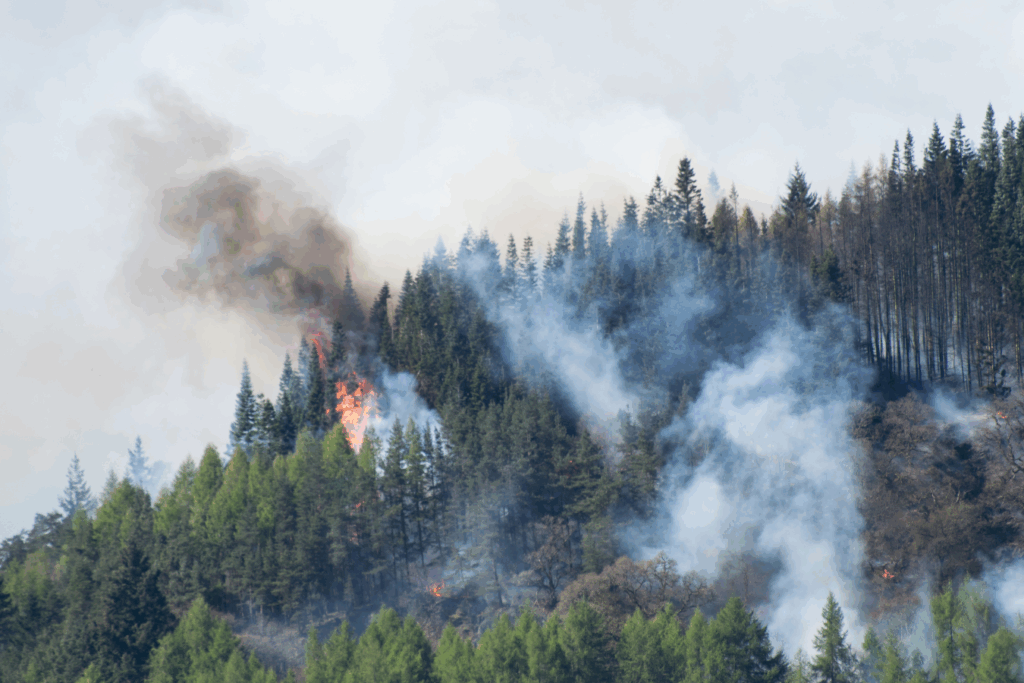
Insurance companies are getting wise to this pattern. Their risk models now factor in the type, age, and density of vegetation around properties when setting rates. If you live near industrial timber plantations, that’s increasingly being counted as a strike against you.
The numbers are staggering. Between 2020 and 2022, insurance companies refused to renew 2.8 million homeowner policies in California. In Los Angeles County alone, that was 531,000 policies. State Farm dropped nearly 70% of its policies in Pacific Palisades before the recent devastating fires there.
The recent Los Angeles fires are expected to cost insurers over $20 billion, making them the most expensive wildfire in U.S. history. This kind of loss makes insurance companies even more skittish about writing policies in fire-prone areas.
What does this mean for you? If you live in an area surrounded by industrial timber operations, you’re more likely to:
- Pay higher premiums
- Have your policy cancelled
- Be forced onto California’s FAIR Plan, which offers basic coverage at high cost
- Struggle to find any coverage at all
Recent economic research found that wildfire risk has already reduced the value of western timberland by about 10%—that’s $11.2 billion in losses across three Pacific states. But homeowners are bearing much of the financial burden through higher insurance costs and reduced property values.
The Hidden Water Crisis
While everyone focuses on fire, there’s another problem that gets less attention: industrial plantations are water hogs.
Scientific studies show that plantation forests can consume 4 to 10 inches more water per year than grasslands. Fast-growing tree species planted for timber production have massive water appetites, especially during summer when water is already scarce.
Research on Eucalyptus plantations found that removing all the trees from a watershed increased streamflow by 90%. That’s not necessarily the solution anyone wants, but it shows just how much water these industrial forests consume.
In drought-prone Lassen County, this matters. When timber companies replant after fires with fast-growing species designed for quick harvest, they’re essentially installing massive water pumps across the landscape. Less water means:
- Stressed natural vegetation that burns more easily
- Reduced stream flows affecting fish and wildlife
- Less groundwater recharge
- Competition with human water needs
Yet there’s virtually no public oversight of how post-fire replanting decisions affect regional water resources. The same public funds that pay for these projects could be used to restore natural forests that are both more fire-resistant and use water more efficiently.
Follow the Money: When “Fire Prevention” Meets Profit
Here’s where things get uncomfortable. Post-fire recovery operations often blur the line between environmental restoration and resource extraction.
After a fire, there’s typically a rush of activity: salvage logging to remove “dangerous” burned trees, hazard tree removal along roads, and replanting efforts. All of this is often funded with public disaster dollars and justified as necessary for public safety.
But these operations frequently coincide with timber harvests that benefit private landowners. The same companies involved in post-fire “recovery” are also in the business of growing and harvesting trees for profit.
The project pipeline often looks like this:
- Fire burns through mixed public and private lands
- Cal Fire funding becomes available for “recovery” and “fire prevention”
- HLVRCD administers the money and directs it to LFSC
- LFSC hires contractors—often the same timber companies that own adjacent land
- “Recovery” activities include salvage logging and replanting with fast-growing species
- In 10-20 years, those same areas may be harvested again
The public pays for it, but private timber companies often benefit. Meanwhile, the replanting choices made with public dollars may recreate the same plantation conditions that made the area burn severely in the first place.
The Insurance Death Spiral
This creates a vicious cycle. Industrial forestry practices create fire-prone landscapes. Those landscapes increase insurance risk. Insurance companies respond by raising rates or refusing coverage. Property values decline. Communities struggle economically. But the forestry practices continue because they’re profitable and largely unregulated.
The recent Los Angeles fires are accelerating this cycle. Insurance Commissioner Ricardo Lara had just rolled out new regulations meant to bring insurers back to the California market by allowing them to use climate models and pass reinsurance costs to consumers. The idea was that higher rates would be acceptable if coverage became available again.
But catastrophic losses like the LA fires make insurers question whether any rate is high enough to justify the risk. As one insurance expert told NPR, “We’re marching toward a future where insurance is not going to be available or affordable.”
For rural communities surrounded by industrial timberlands, this could mean economic death. Without insurance, you can’t get a mortgage. Without mortgages, property values collapse. Without economic activity, communities fade away.
What Needs to Change
The current system isn’t working for anyone except the timber companies. Here’s what needs to happen:
Immediate Transparency Fixes:
- All publicly funded forest projects should be mapped online with full contractor and funding details
- Complete disclosure of what chemicals are being used where
- Clear conflict-of-interest rules when contractors have timber interests in project areas
- Public comment periods before major planting decisions
Bigger Picture Reforms:
- Independent scientific review of how different forest management approaches affect fire risk, water use, and insurance costs
- Coordination between water agencies, insurance regulators, and forest managers
- Community oversight with real authority over projects affecting their areas
- Long-term monitoring to see if projects actually reduce fire risk
Rethinking Forest Management:
- Prioritizing fire-adapted native forests over fast-growing plantations in high-risk areas
- Protecting critical watershed areas from industrial planting
- Strategic placement of different vegetation types to create natural firebreaks
- Using public funds for genuine public benefit, not private profit
The Path Forward
The evidence is clear: continuing to replant fire-prone industrial plantations with public money while calling it “fire prevention” is making our problems worse. These practices increase fire risk, consume precious water resources, and contribute to insurance market collapse.
Climate change is making this problem urgent. We can’t keep doing the same things and expecting different results. The recent LA fires show what happens when extreme weather meets flammable landscapes—and similar conditions exist across much of rural California.
Lassen County residents deserve forest management that actually makes them safer, not forest management that enriches timber companies while increasing community risk. That means demanding transparency, independent oversight, and management practices based on science rather than profit.
The stakes are too high for business as usual. Your insurance rates, your property values, and your community’s future depend on getting this right.
Sources and References
Lindenmayer, D.B., et al. (2022). “Better managing fire in flammable tree plantations.” Forest Ecology and Management. https://www.sciencedirect.com/science/article/abs/pii/S0378112722006351
Zald, H.S. & Dunn, C.J. (2018). “High wildfire severity risk seen in young plantation forests.” Oregon State University. https://today.oregonstate.edu/news/high-wildfire-severity-risk-seen-young-plantation-forests
Conservation Northwest. (2018). “Private timber plantations burn more severely than adjacent public forests.” https://conservationnw.org/private-timber-plantations-burn-more-severely-than-adjacent-public-forests/
Eco-Integrity Alliance. (2024). “Wildfire ‘Fuel Reduction’ Scientific Studies.” https://eco-integrityalliance.org/wildfire-fuel-reduction-scientific-studies/
Klamath-Siskiyou Wildlands Center. “Plantations Burn Hotter.” https://www.kswild.org/plantations-burn-hotter
Bayham, J., et al. (2023). “Wildfires and climate change have lowered the economic value of western U.S. forests.” Journal of Environmental Economics and Management. https://www.sciencedirect.com/science/article/pii/S0095069623001122
CalMatters. (2025). “LA fires could worsen California’s stressed insurance market.” https://calmatters.org/economy/2025/01/la-fires-california-insurance/
The Washington Post. (2025). “How the LA wildfires will affect home insurance in California.” https://www.washingtonpost.com/climate-environment/2025/01/09/california-wildfire-palisades-homeowners-insurance/
Insurance Business America. (2025). “California expands FAIR Plan insurance limits amid escalating wildfire risk.” https://www.insurancebusinessmag.com/us/news/catastrophe/california-expands-fair-plan-insurance-limits-amid-escalating-wildfire-risk-and-market-strain-530334.aspx
NBC News. (2025). “Los Angeles wildfires magnify California ‘insurance crisis’.” https://www.nbcnews.com/news/us-news/los-angeles-wildfires-rage-as-homeowners-battle-insurance-crisis-rcna186783
NPR. (2025). “California’s wildfires may also be catastrophic for its insurance market.” https://www.npr.org/2025/01/13/nx-s1-5256381/californias-wildfires-insurance-market
Bloomberg. (2025). “Climate Change Risks Cracking California’s Insurance Market Wide Open.” https://www.bloomberg.com/graphics/2025-los-angeles-wildfires-insurance/
NBC Los Angeles. (2025). “California home insurance: How LA area wildfires impact market.” https://www.nbclosangeles.com/news/local/los-angeles-wildfires-california-home-insurance-impact/3600485/
CNN Business. (2025). “California’s insurance is in crisis.” https://www.cnn.com/2025/01/09/business/california-wildfires-homeowners-insurance/index.html
California FAIR Plan. “Home page.” https://www.cfpnet.com/
Forrester, D.I. (2015). “Transpiration and water-use efficiency in mixed-species forests versus monocultures.” Tree Physiology. https://academic.oup.com/treephys/article/35/3/289/1648522
Tian, J., et al. (2023). “Forest water-use efficiency: Effects of climate change and management.” Forest Ecology and Management. https://www.sciencedirect.com/science/article/abs/pii/S0378112723000865
Lima, W.P., et al. (2012). “Forest Plantations and Water Consumption: A Strategy for Hydrosolidarity.” International Journal of Forestry Research. https://onlinelibrary.wiley.com/doi/10.1155/2012/908465
Ferraz, S.F.B., et al. (2018). “Hydrological effects of forest plantation clear-cut on water availability.” Journal of Hydrology. https://www.sciencedirect.com/science/article/pii/S2214581817303531
Zhang, C., et al. (2021). “Consumption of precipitation by evapotranspiration in broadleaved and coniferous plantations.” Science of the Total Environment. https://www.sciencedirect.com/science/article/abs/pii/S037837742100192X