
Information for Property Owners: Important Considerations About LFSC Herbicide Practices
If you’ve signed or are considering signing a landowner agreement with the Lassen Fire Safe Council (LFSC), you need to understand the serious risks that extend beyond your land to potential legal and financial liability. Protect Lassen is publishing this information about the herbicides used in LFSC projects because LFSC refuses to do so. When asked why the organization does not disclose this critical information to the public, LFSC Managing Director Cade Mohler responded that “LFSC is not a pesticide regulation, education, or enforcement-based organization so we do not post specifics about herbicide and are not required to by law to do so.” Despite the widespread use of toxic chemicals across Lassen County forestlands under LFSC’s direction, the organization claims that “it is not LFSC’s mission or responsibility to educate or notify the public to every hazard that may exist in forestry and wildfire mitigation.”
Given these statements and LFSC’s continued refusal to publish details about chemical use, it appears that the organization does not want to publicly admit to the toxic herbicides being applied across thousands of acres in Lassen County. This lack of transparency raises serious questions about oversight, environmental accountability, and landowner rights.
These statements underscore the need for community-led transparency. Protect Lassen is stepping in to expose what LFSC won’t: the herbicides being used, where they are being applied, and the environmental and legal risks landowners and neighbors now face.
Hidden Chemical Use Not Disclosed in Your Contract
LFSC appears to be coordinating or facilitating herbicide applications across Lassen County using mixtures of chemicals. However, the landowner agreement you’re asked to sign appears to contain no specific disclosure of:
- Which herbicides will be used on your property
- Their active ingredients or health risks
- Potential drift concerns to neighboring properties
- Groundwater contamination risks
- Long-term ecological impacts
Complete List of Herbicides Used by LFSC
Based on LFSC’s documentation and correspondence, these appear to be the herbicides that may be used on your property:
Site Preparation Herbicides:
- Velossa (Active ingredient: Hexazinone)
- Velpar DF (Active ingredient: Hexazinone)
- Cleantraxx (Active ingredients: Penoxsulam, Oxyfluorfen)
- Esplanade F (Active ingredient: Indaziflam)
- Roundup Pro or Custom (Active ingredient: Glyphosate)
- Garlon XRT (Active ingredient: Triclopyr)
- Garlon 3A Green formulation (Active ingredient: Triclopyr)
- Garlon 4A Amine formulation (Active ingredient: Triclopyr)
- MSO (Methylated Seed Oil) – Adjuvant/Drift control agent
- Hi-Light Blue Dye – Spray area marking
Plantation Release Herbicides:
- Roundup Pro or Custom (Active ingredient: Glyphosate)
- Garlon XRT (Active ingredient: Triclopyr)
- Garlon 3A (Active ingredient: Triclopyr)
- Garlon 4A (Active ingredient: Triclopyr)
- MSO (Methylated Seed Oil) – Adjuvant/Drift control agent
- Hi-Light Blue Dye – Spray area marking
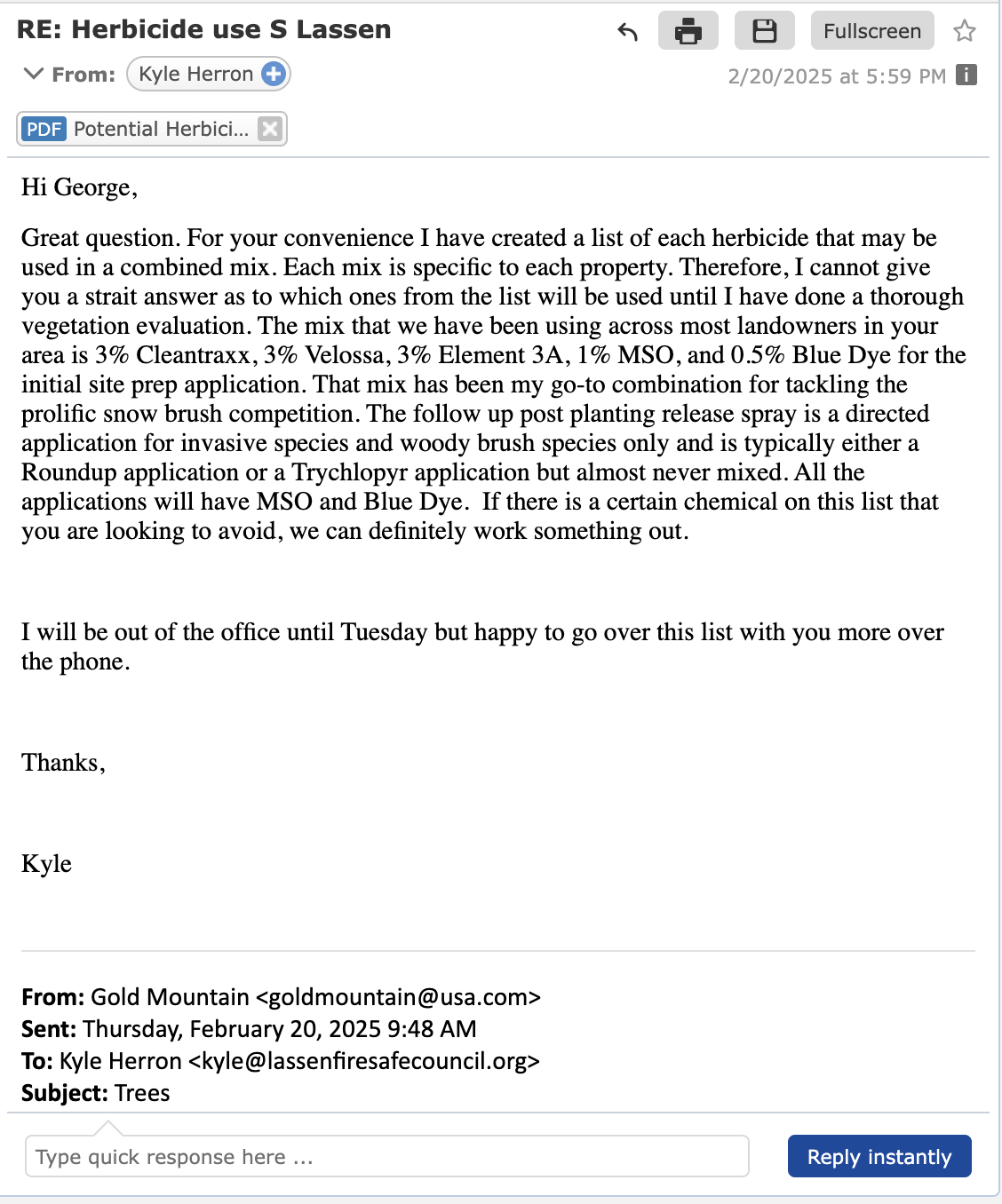
In an email from February 2025, LFSC Project Manager Kyle Herron reportedly referenced using: “3% Cleantraxx, 3% Velossa, 3% Element 3A, 1% MSO, and 0.5% Blue Dye for the initial site prep application” as his “go-to combination for tackling the prolific snow brush competition.”
These chemicals are documented to have environmental and health considerations, yet this information does not appear to be included in the contract materials provided to landowners.
Environmental Monitoring Practices
LFSC’s statement about their environmental practices raises serious questions:
“LFSC does not collect residual soil samples or water samples and is not required to do so.” —Cade Mohler, LFSC Director, March 26, 2025
According to available documents, LFSC appears to be applying these chemicals across large areas of steep mountain terrain without conducting any environmental testing. The Diamond Mountains contain interconnected springs, seasonal streams, and underground water systems that feed into private wells, wetlands, and critical watershed zones. Without pre-application testing or post-application monitoring, there is no way to determine where these chemicals travel or how long they persist.
LFSC has no data on how these herbicides are affecting soil health, aquatic life, livestock, domestic water systems, or the long-term ecological stability of treated lands—because they do not collect any. Protect Lassen believes this is not an oversight, but a deliberate omission. If LFSC were to conduct meaningful environmental testing, the results could expose alarming truths about chemical drift, water contamination, and the broader impact of their reforestation model. By choosing not to test, LFSC avoids accountability—and the public remains uninformed about the risks these chemicals may pose to the health of people, wildlife, and ecosystems throughout Lassen County.
The Financial Clause Worth Noting
The contract contains a clause that landowners should be aware of:
“If Landowner terminates this agreement, Landowner shall be liable for all actual costs incurred up to the date of termination.” (Section 8.1)
This means if you sign now, but later discover concerning information about herbicides and wish to opt out, you’ll still be responsible for paying for all work already completed. With site preparation and mastication costs potentially running into thousands of dollars, this could make it financially challenging for landowners to withdraw once they learn the full scope of chemical use.
Herbicides Being Used in LFSC Projects
Has Kyle Herron of LFSC spoke with you about Herbicides prior to March 11th 2025?
Combined Herbicide Cocktails: Greater Risk, Less Oversight
Lassen Fire Safe Council’s own project manager, Kyle Herron, confirmed in a February 2025 email that he uses a standard “go-to combination” for site preparation that includes Cleantraxx (Penoxsulam + Oxyfluorfen), Velossa (Hexazinone), Element 3A (Triclopyr), MSO (a surfactant/adjuvant), and blue dye—all mixed together.
“3% Cleantraxx, 3% Velossa, 3% Element 3A, 1% MSO, and 0.5% Blue Dye for the initial site prep application” — Kyle Herron, LFSC Project Manager
This practice introduces significant and largely unmonitored environmental risks:
- Synergistic toxicity: Scientific studies have demonstrated that mixtures of herbicides can exhibit synergistic effects—meaning the combination is more toxic than the individual components alone. These effects are especially pronounced in aquatic species such as fish, amphibians, and invertebrates (Pape-Lindstrom et al., 1997; Belden et al., 2007).
- Increased environmental persistence: Surfactants like MSO can enhance the solubility and transport of herbicides in water and soil, making them more likely to migrate beyond intended treatment areas (USEPA, 2010). Combining persistent chemicals like Hexazinone and Indaziflam with drift agents may increase their potential to contaminate groundwater and surface water.
- Regulatory gaps: While herbicides are reviewed and registered by the EPA individually, there is little to no federal testing or regulation of chemical mixtures as they are actually applied in the field. The cumulative effects of multi-herbicide tank mixes remain largely unstudied in forestry contexts, despite widespread use (Gross et al., 2010; Richardson et al., 2019).
Despite these risks, LFSC has publicly stated that it does not conduct pre-application or post-application soil or water testing, and has no publicly available monitoring data related to these chemical mixtures.
Sources:
- Belden, J. B., et al. (2007). “Mixture toxicity of herbicides in aquatic systems.” Environmental Toxicology and Chemistry, 26(11), 2216–2224.
- Pape-Lindstrom, P. A., & Lydy, M. J. (1997). “Synergistic toxicity of atrazine and organophosphate insecticides to Daphnia magna.” Environmental Toxicology and Chemistry, 16(12), 2550–2556.
- U.S. Environmental Protection Agency (USEPA). (2010). “Pesticide Registration Notice 2010-1: Labeling of pesticide products containing surfactants.” Washington, DC.
- Gross, M. (2010). “Pesticide mixtures may act synergistically.” Current Biology, 20(12), R521–R522.
- Richardson, J. R., et al. (2019). “Environmental mixture research: insights and recommendations.” Toxicological Sciences, 172(2), 265–276.
Herbicides and Their Effects on Water, Wildlife, and Public Health
The herbicides reportedly used by LFSC—including Velossa, Cleantraxx, Roundup, and Garlon formulations—pose serious documented risks to water quality, wildlife, livestock, and human health. These risks are compounded by the absence of environmental testing, monitoring, or public disclosure prior to application.
1. Water Contamination
Several of the herbicides have high leaching potential, meaning they can seep into groundwater or be carried by runoff into streams, springs, and wells. This poses a direct threat to both private water supplies and regional watersheds. Some chemicals leave long-lasting residues that persist in the soil and water for extended periods.
2. Wildlife Toxicity
These products are toxic to aquatic life such as fish, amphibians, and aquatic insects, with some disrupting reproductive cycles. Others affect birds and mammals, creating ripple effects through the entire local food web. Habitat contamination can lead to long-term ecosystem damage.
3. Livestock and Agricultural Impact
Cattle, sheep, and other grazing animals may be at risk from exposure to contaminated forage or water. Certain herbicides in use may cause organ damage, reproductive harm, or neurological issues in livestock. Drift from treated areas may also affect neighboring crops and vegetation, potentially damaging food sources and organic operations.
4. Human Health Risks
The active ingredients in these herbicides have been linked to:
- Neurotoxicity
- Carcinogenic effects
- Liver and kidney damage
- Respiratory irritation
- Endocrine disruption
In some cases, eye, skin, and nervous system irritation can occur from low-level exposure. The long-term health risks are still being studied, especially for residents living near repeated spray zones.
5. Private Property and Legal Liability
Landowners who sign onto LFSC projects may unknowingly assume liability for soil contamination, vegetation damage, and drift-related lawsuits—even when caused by contractors. These herbicides can persist in the environment and lead to claims of environmental damage or water pollution, increasing the financial and legal exposure of the landowner.
How Herbicides Affect Groundwater and Drinking Water Sources
Many of the herbicides identified in LFSC projects are known to contaminate surface water and groundwater, especially in forested and mountainous regions like Lassen County where soil permeability, slope, and rainfall increase runoff and leaching risks.
Documented Groundwater Contaminants
Several active ingredients used in site preparation and release herbicide mixtures have been found in groundwater and drinking water wells in California and across the U.S.:
- Glyphosate (Roundup Pro/Custom):
While glyphosate binds to soil, it can still reach water supplies through erosion and sediment runoff. It has been detected in surface waters, ditches, and streams following forestry spraying. Long-term persistence and its byproduct AMPA raise ongoing concerns. - Hexazinone (Velossa, Velpar DF):
One of the most mobile and groundwater-prone herbicides used in forestry. Frequently detected in both surface water and drinking water wells, particularly in areas with sandy or decomposed granite soils. The EPA lists it as a high leaching risk chemical. - Triclopyr (Garlon series):
This herbicide is moderately persistent and has been shown to enter surface waters through drift and runoff, especially in sloped terrains or during rain events. Toxic to aquatic life even in small concentrations. - Indaziflam (Esplanade F):
A newer herbicide with long soil persistence. Known to migrate laterally in soil, especially in areas with slopes or loose substrate. Manufacturer data indicates caution near sensitive groundwater zones. - Oxyfluorfen (Cleantraxx):
Highly toxic to aquatic organisms. Tends to bind to sediment but can still enter waterways through erosion or improper buffer zones. - Penoxsulam (Cleantraxx):
Mobile in water and toxic to aquatic plants. It is persistent in aquatic environments and difficult to break down under natural conditions.
Risk Factors for Lassen County
The Diamond Mountains and surrounding regions contain interconnected springs, ephemeral streams, and fractured volcanic aquifers that increase the chance of herbicide migration into water sources.
LFSC has publicly admitted it does not test soil or water before or after herbicide applications, meaning there is no monitoring of contamination levels or downstream movement.
Wind drift and post-application rainfall and snow melt runoff are the most common pathways for herbicides to reach water, especially without proper buffers or containment plans.
Regulatory Notes
EPA and USGS data show that forest herbicide applications can be a major contributor to watershed contamination in rural areas.
Many herbicides used in forestry projects are subject to buffer zone regulations, yet enforcement is inconsistent, and landowner agreements often fail to address these requirements.
Persistence of Forestry Herbicides in Groundwater
In groundwater, forestry herbicides can persist much longer—often months to years—because sunlight, microbial activity, and oxygen (which help break down chemicals) are minimal or absent underground.
Below is a summary of how long the most common herbicides used in logging can remain active or detectable in groundwater, along with their environmental risks.
Hexazinone (Velpar)
- High leaching potential; very water-soluble
- Frequently detected in shallow wells and groundwater after forestry use
- Persistence:
- Can remain active in groundwater for 1–3 years
- May migrate through soil after rain events or snowmelt
- EPA-classified as a known groundwater contaminant
- Toxic to aquatic plants and potentially harmful to drinking water
Imazapyr (Arsenal, Habitat)
- Highly mobile in soil, especially in sandy or disturbed areas
- Can contaminate both groundwater and surface water
- Persistence:
- May remain biologically active for up to 1–2 years in subsurface water
- Not always easy to detect without specific lab testing
Indaziflam (Esplanade)
- Very persistent in soil, with potential for slow migration into groundwater
- Long-term concern, even at low levels
- Detected in groundwater monitoring programs at forest and roadside sites
- Toxic to aquatic plants at very low concentrations
Triclopyr (Ester Form) (Garlon 4)
- Moderate risk to groundwater, especially in permeable soils or sloped terrain
- More likely to affect shallow groundwater or areas with fractured rock
- Persistence:
- Can be present in subsurface water for several months
- Particularly risky in karst terrain or recharge zones for wells
Glyphosate (Roundup)
- Generally binds to soil, so low leaching under normal conditions
- In disturbed or eroded areas, it can enter shallow groundwater
- Has been detected in wells near logging roads or firebreaks
Disclaimer:
The information provided on this page is for informational and public awareness purposes only. It does not constitute legal advice, and no attorney-client relationship is created by viewing or referencing this material. Landowners and residents are encouraged to consult with qualified legal counsel regarding any specific concerns related to property rights, chemical exposure, liability, or land use agreements.