
Table of Contents
Jeffrey Ta Threatens Transparency Advocate on Behalf of Lassen Fire Safe Council
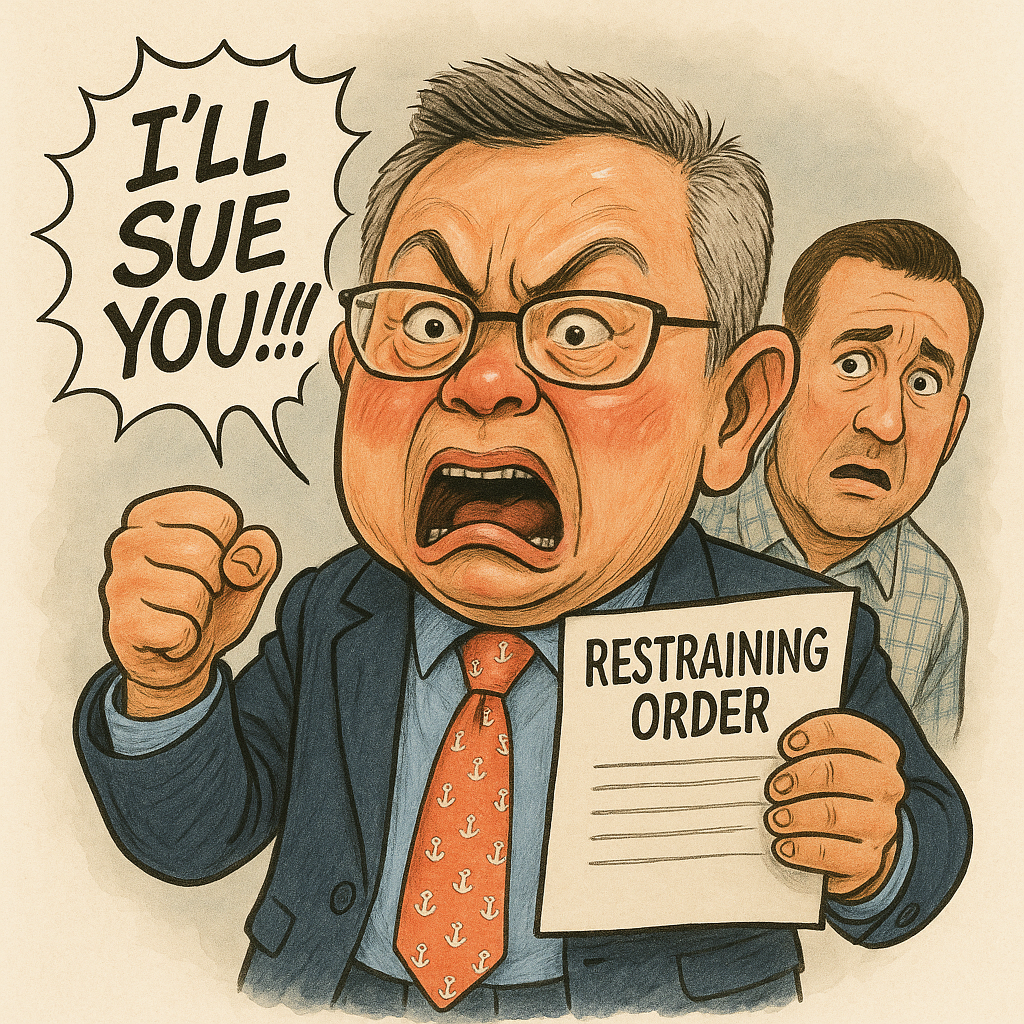
For years, the Lassen Fire Safe Council (LFSC) has marketed itself as a community-led nonprofit working to reduce wildfire risk. But behind the branding lies something much darker: a well-connected operation funneling public money into private timber projects, suppressing oversight, and using legal intimidation — including threats from their attorney Jeffrey Ta — to silence those who ask questions.
On March 11, 2024, I asked whether Kyle Herron — LFSC’s Project Manager — was legally certified to provide pesticide advising. At the time I submitted my inquiry, Herron was not licensed. The very next day, a license appeared under his name. Once that occurred, I sent a formal letter to LFSC Board Chair Ruth Morentz asking whether she and Executive Director Cade Mohler had known Herron was previously unlicensed, and if so, what they intended to do about it. These were valid questions grounded in public health and safety. I received no answers.
Instead, I was threatened.
On March 25, 2024, Attorney Jeffrey Ta — writing on behalf of LFSC — accused me of harassment for submitting lawful inquiries and public records requests. The allegation was false, and no legal action followed. When I pushed back on the bogus claim and asked for clarification, Ta never responded. As of today, June 22, 2025, it has been 89 days. The threat was never meant to hold up in court — it was meant to silence me.
Ruth Morentz, who was copied on our exchange, never replied either. Nor did she address the detailed factual corrections I sent after she circulated misleading claims about LFSC’s practices. On its website, LFSC describes itself as a grassroots community-based organization, but the facts suggest otherwise.
Jeffrey Ta & LFSC Ignores CPRA Requests and Misstates the Law
Despite promoting itself as a transparent, community-oriented nonprofit, the Lassen Fire Safe Council has flatly ignored two formal California Public Records Act (CPRA) requests submitted in March and April 2025. These requests sought legally disclosable records — including pesticide use reports, internal herbicide-related communications, environmental data, and GIS maps — all tied to a publicly funded project covering thousands of acres in Lassen County.
LFSC never produced a single document.
In their only formal response — dated March 26, 2025 — LFSC did not even mention CPRA. Instead, they falsely claimed that as a private 501(c)(3), they are not subject to the Brown Act, Freedom of Information Act, or California Open Records requirements. This is legally incorrect.
LFSC receives millions of dollars in public funding and is actively implementing state- and federally funded wildfire recovery and vegetation management projects. Under multiple California court rulings, including Community Youth Athletic Center v. National City and Marks v. CSU, private organizations that perform public functions or receive public funds are subject to CPRA.
The law is clear. LFSC is not immune.
Their denial wasn’t legal — it was strategic. They ignored document requests, produced no records, and instead tried to paint their response as voluntary. That’s not transparency — it’s obstruction.
Evasion in Place of Answers
When LFSC finally responded to my original questions, their answers were evasive, incomplete, or outright deflective. Despite my detailed, evidence-based inquiries — many of which involved public health, legal compliance, and environmental risk — LFSC avoided direct answers and instead relied on vague, legally coached language.
Their answers were clearly written by LFSC’s attorney — not staff — and were framed to shield the organization from liability, not to provide clarity or accountability to the public.
For example:
- They repeatedly deflected responsibility for herbicide decisions, even though internal emails and project documentation show that LFSC provided landowners with site-specific chemical lists and oversaw implementation.
- They refused to disclose which herbicides would be used, claiming the information wasn’t available or finalized — yet applications were already occurring across large acreages.
- They offered general statements about “best practices” instead of concrete data, such as drift mitigation plans, environmental testing, or buffer zone mapping.
- They dismissed my documentation-based concerns with rhetoric, falsely suggesting I was “confused” or “incorrect,” without actually disproving a single point I raised.
Their response did not meet the standard of transparency, environmental integrity, or legal accountability — especially for an organization using public money to carry out large-scale herbicide operations.
The evasiveness was not accidental. It was tactical — meant to exhaust, discredit, and delay rather than inform.
George Jacobsen
Protect Lassen
Does LFSC Have a Project Near You?
If you’ve been affected by LFSC projects or denied public records from any agency receiving wildfire recovery funds, contact us at watch@protectlassen.org. We’re tracking suppression, contamination, and illegal herbicide activity across Lassen County.
Full Transparency from Protect Lassen
Kyle Herron, Cade Mohler, and Ruth Morentz have repeatedly refused to answer direct questions about licensing, oversight, and accountability — including whether Herron was legally authorized to provide pesticide advising when he began coordinating chemical treatments across Lassen County.
Rather than respond transparently, the Lassen Fire Safe Council chose to have their attorney, Jeffrey Ta, threaten me with legal action. His letter accused me of “harassment” for submitting lawful public records requests and asking questions — an obvious attempt to intimidate and shut down further inquiry.
Protect Lassen believes the public has a right to ask these questions — and to receive honest, document-backed answers. If public funds are being used, the public has the right to know how, where, and by whom. Silence and legal threats are not acceptable substitutes for accountability.