
The Timber Industry’s Hidden Hand: Exposing the Truth Behind the Lassen Fire Safe Council
Table of Contents
Who’s Really Behind Lassen’s Wildfire Projects?
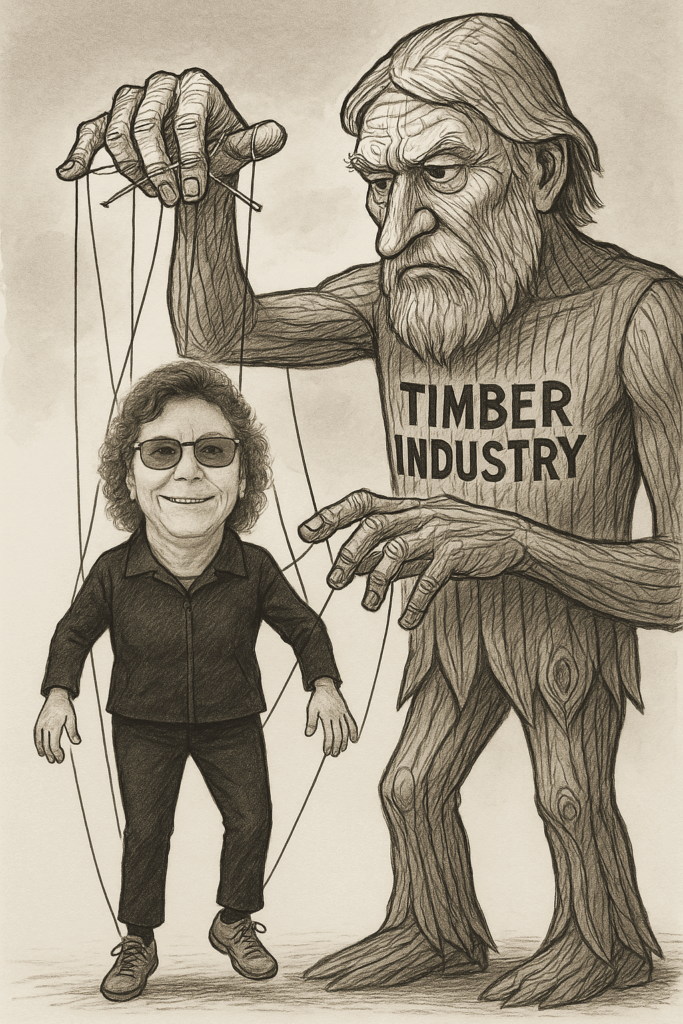
The Lassen Fire Safe Council (LFSC) presents itself as a grassroots, community-based nonprofit committed to fire safety and forest recovery. But in reality, LFSC functions as a publicly funded instrument of the commercial timber and biomass industries, funneling millions in taxpayer dollars into logging, herbicide, and biomass operations under the guise of environmental restoration.
LFSC isn’t grassroots. It isn’t independent. And it isn’t honest about the scale or purpose of its operations.
Despite promoting transparency and public accountability, LFSC actively avoids meaningful environmental review. While they do file documents under the California Environmental Quality Act (CEQA), they routinely exploit loopholes designed for small-scale, low-impact projects:
- They file categorical exemptions for operations that cover thousands of acres—falsely claiming their work falls under “minor alterations to land.”
- When exemptions won’t suffice, they submit mitigated negative declarations (MNDs)—documents that claim all impacts have been addressed without requiring full Environmental Impact Reports (EIRs).
- They break large, landscape-scale projects into smaller filings to avoid CEQA’s requirement for cumulative impact review, even though meeting minutes and maps show these are part of a single, coordinated operation.
For example, in 2024 alone, LFSC documented treating over 15,000 acres across 425 properties in Lassen County, receiving more than $12.5 million in CalFire funding. These massive interventions included over 3,496 acres of herbicide application, biomass extraction, monoculture replanting, and extensive soil disturbance—none of which were subjected to full CEQA analysis.
These activities are not just permitted—they are strategically shielded from scrutiny by a regulatory process that LFSC manipulates through segmentation, vague documentation, and agency complacency.
Meanwhile, timber industry partners like SPI and W.M. Beaty & Associates appear in LFSC meetings regularly, helping direct these “fire recovery” efforts, while Laurence Crabtree, LFSC’s Vice Chair, simultaneously represents Golden State Natural Resources (GSNR)—the biomass nonprofit converting wildfire forests into wood pellets for international export.
These are not isolated projects. They are part of a commercial forest conversion pipeline, facilitated by CEQA loopholes, paper compliance, and a total absence of county, state and environmental oversight.
Leadership Ties to Timber and Biomass Interests
LFSC’s leadership is deeply embedded in the very industries that benefit from its projects. While the organization presents itself as a neutral wildfire resilience nonprofit, its key staff and board members are veterans of the commercial timber, utility vegetation, and biomass export sectors.
Cade Mohler – Executive Director
Mohler worked for Sierra Pacific Industries (SPI) for over a decade before taking over leadership of LFSC. SPI is one of California’s largest private landowners and a driving force behind industrial post-fire salvage, monoculture replanting, and herbicide use. Mohler’s past employment at SPI raises major concerns about regulatory capture and conflict of interest, especially given SPI’s ongoing role in LFSC-coordinated projects.
Kyle Herron – Project Coordinator
Herron’s resume includes work for multiple timber and vegetation management firms, including time as a reforestation technician for SPI, as well as vegetation contractor positions focused on herbicide applications and timber planting operations. As LFSC’s boots-on-the-ground coordinator, he oversees field operations involving chemical spraying, tree removal, and contractor deployment—functions that closely mirror private industry roles rather than community-based land stewardship.
Laurence Crabtree – Vice Chair, Board of Directors
Crabtree is a retired Forest Supervisor from the U.S. Forest Service and now serves multiple overlapping roles that directly benefit the timber and biomass industries. He runs Crabtree Forestry Consulting, a private firm that assists timberland owners and logging companies with harvest planning, permitting, and forest management operations.
In addition to his private consulting business, Crabtree is a paid consultant for Golden State Natural Resources (GSNR)—a biomass nonprofit seeking to convert fire-damaged forests into wood pellets for international energy markets.
His dual leadership roles in LFSC and GSNR, combined with his private forestry business, create layered and ongoing conflicts of interest. The same man advising GSNR on how to profit from wildfire landscapes is helping guide LFSC projects that facilitate those profits—while presenting it all as community-driven recovery.
Meeting records confirm Crabtree uses his position at LFSC to promote GSNR’s mission and steer projects toward industrial biomass extraction and plantation-style replanting.
How the Biomass Pipeline Works
LFSC promotes its projects as wildfire recovery and public safety efforts, but behind the scenes, they serve as a taxpayer-funded supply chain for the biomass and timber industries. Much of the forest material removed during these projects—especially standing fire-killed trees—is not waste. It’s high-value commercial biomass.
Despite the charred appearance, most of these trees are only burned on the bark. The wood inside remains intact, structurally sound, and perfectly usable for biomass energy and wood pellet manufacturing. In some cases, it’s even suitable for lumber.
Instead of logging companies paying for this material, the public is paying them to take it.
Two Main Biomass Destinations
- Honey Lake Power – Local Biomass Electricity
In Lassen County, LFSC projects feed large volumes of forest material into the Honey Lake Power biomass plant near Wendel. In 2024, meeting minutes confirm up to 80 truckloads per day were delivered to this facility from LFSC-coordinated fuel breaks and thinning projects. The plant burns wood to produce electricity, which is sold to utilities and industry.
While promoted as “clean” or “green,” this type of energy production emits significant air pollution and greenhouse gases. Yet, the biomass is subsidized by taxpayers—who unknowingly pay for forest clearing under the false banner of wildfire protection.
- Golden State Natural Resources (GSNR) – International Pellet Export
GSNR is constructing massive wood pellet facilities in Bieber and Jamestown, California, with plans to export up to 700,000 metric tons per year to power stations in Japan, South Korea, the UK, and the EU.
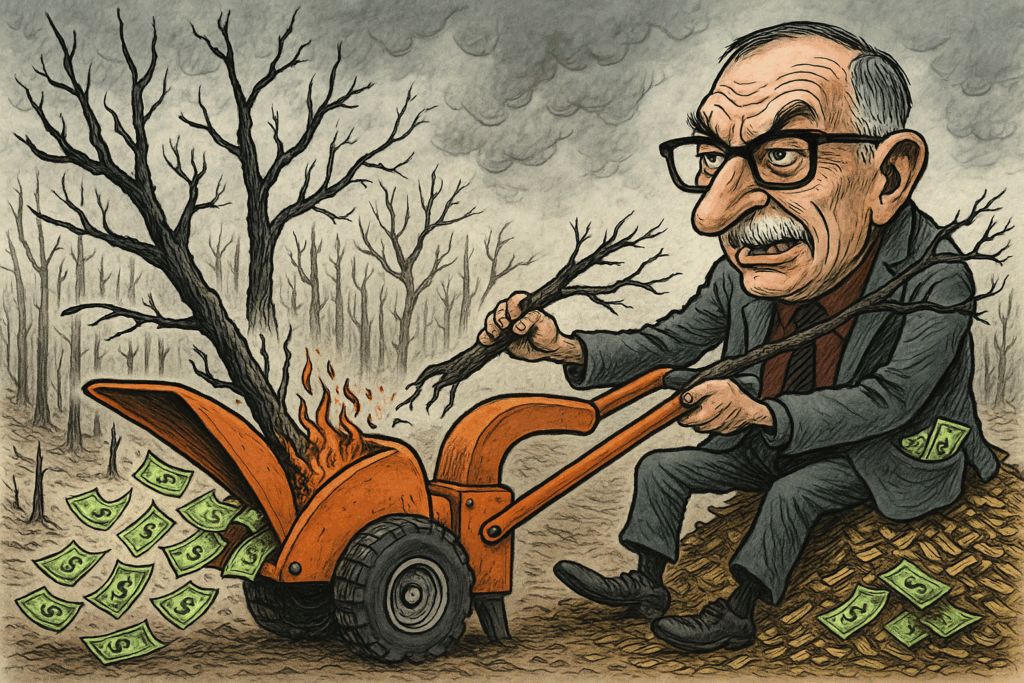
LFSC is directly connected to GSNR through its vice chair, Laurence Crabtree, who is a paid GSNR consultant. Their combined model depends on:
- Post-fire landscapes cleared under emergency pretense
- Public funding for labor, access roads, and material removal
- Fast-growing conifer plantations replanted for future harvest
- No CEQA review of long-term ecological harm
The result is a closed-loop pipeline where taxpayers fund the extraction and delivery of raw biomass, and private interests reap the profits—all while marketing it as restoration.
Monoculture Replanting Isn’t Reforestation
True reforestation after wildfire means working with nature: allowing native vegetation to recover, supporting biodiversity, and respecting natural regeneration cycles. But that’s not what Lassen Fire Safe Council is doing.
Instead, LFSC and its contractors are engaged in industrial replanting programs that prioritize fast-growing, commercially profitable species like ponderosa pine and Douglas fir. These trees are planted in tight rows across large areas—creating monoculture plantations, not forests.
In 2024 alone, LFSC and its timber partners planted over 2.4 million seedlings in Lassen County, with plans for millions more. Meeting minutes confirm that helicopter planting and aerial herbicide spraying are used to wipe out native competition and replace it with uniform conifer stands.
LFSC’s website includes educational materials titled “Lesson 1: Fire‑Resilient Landscapes,” where they define resilience as supporting healthy, native ecosystems and preparing landscapes to withstand wildfire. Yet in practice, LFSC is replanting the exact same type of plantation-style forests that recently burned—dense, uniform, and fire-prone.
Why This Matters
- Monocultures are highly flammable. Unlike diverse forests, they lack understory variation and moisture retention, making them more vulnerable to future fires.
- They reduce biodiversity. Native shrubs, hardwoods, and wildlife habitat are erased in favor of timber-compatible species.
- They serve the biomass and timber industries. These plantations are not intended to become natural forests—they’re future harvest zones designed to feed the same pipeline of extraction under a new cycle of “fire recovery.”
This model is not about resilience. It’s about control, and turning wildland into tree farms under the cover of restoration.
Public Pays, Industry Profits
Lassen Fire Safe Council presents itself as a grassroots nonprofit helping communities recover from wildfire. But in reality, the Council acts as a taxpayer-funded delivery system for timber and biomass companies.
Millions of public dollars—from CAL FIRE grants and federal fire recovery funds—are funneled into projects coordinated by Lassen Fire Safe Council. These operations are packaged as “forest restoration” and “wildfire resilience.” The Council uses the language of environmentalism to suggest that its work is green, science-based, and ecologically sound.
For example, their educational materials describe fire as “part of every landscape” and emphasize protecting “healthy, native ecosystems.” Their project descriptions highlight benefits like “carbon sequestration,” “habitat restoration,” and “improved surface water quality”—terms used prominently in initiatives like the Thompson Peak project.
But in practice, these claims don’t hold up.
Despite claiming to improve water quality, Lassen Fire Safe Council oversees large-scale industrial herbicide spraying with no environmental monitoring, no water testing, and no public transparency. Toxic chemicals like glyphosate, triclopyr, and hexazinone are applied over vast terrain—including steep slopes and watersheds—without any systematic assessment of runoff, drift, or long-term contamination. Far from improving water quality, this unchecked chemical use poses an active threat to aquatic systems, soil health, and nearby residents.
They also claim to restore wildlife habitat. But true post-fire landscapes are biologically rich and highly supportive of native species—especially in the first few years after wildfire. Birds, insects, mammals, and native plants thrive in regenerating forests where natural processes are allowed to unfold. Instead of supporting this recovery, Lassen Fire Safe Council eradicates it. They strip away native vegetation and replace it with plantation-style monocultures: single-species conifer stands of uniform age, sprayed with chemicals, and designed for industrial harvest—not ecological health.
The ecological harm is masked by feel-good slogans—while the real beneficiaries are timber and biomass companies.
The entire model is built on a continuous stream of government grants. Lassen Fire Safe Council does not operate like a traditional nonprofit sustained by donations or local community needs. Its survival depends on maintaining a pipeline of taxpayer-funded vegetation removal projects. If the grants stop, the organization collapses. That means the system must keep finding new fires, new fuel breaks, and new “treatment areas”—regardless of whether the work is effective, wanted, or ecologically appropriate.
What the Public Gets
- Loss of native biodiversity and habitat
- Exposure to toxic herbicides through aerial and ground spraying
- Less resilient forests prone to future wildfire
- No transparency and no share in any profits
What Industry Gets
- Free or subsidized access to forest biomass
- Publicly funded labor, logistics, and replanting
- A greenwashed public image that hides commercial motives
- Access to large tracts of land under the banner of “recovery”
This is not ecological restoration. It’s a publicly funded business model where natural landscapes are stripped, sprayed, and replanted to serve industry—and the public is sold a false promise of resilience.