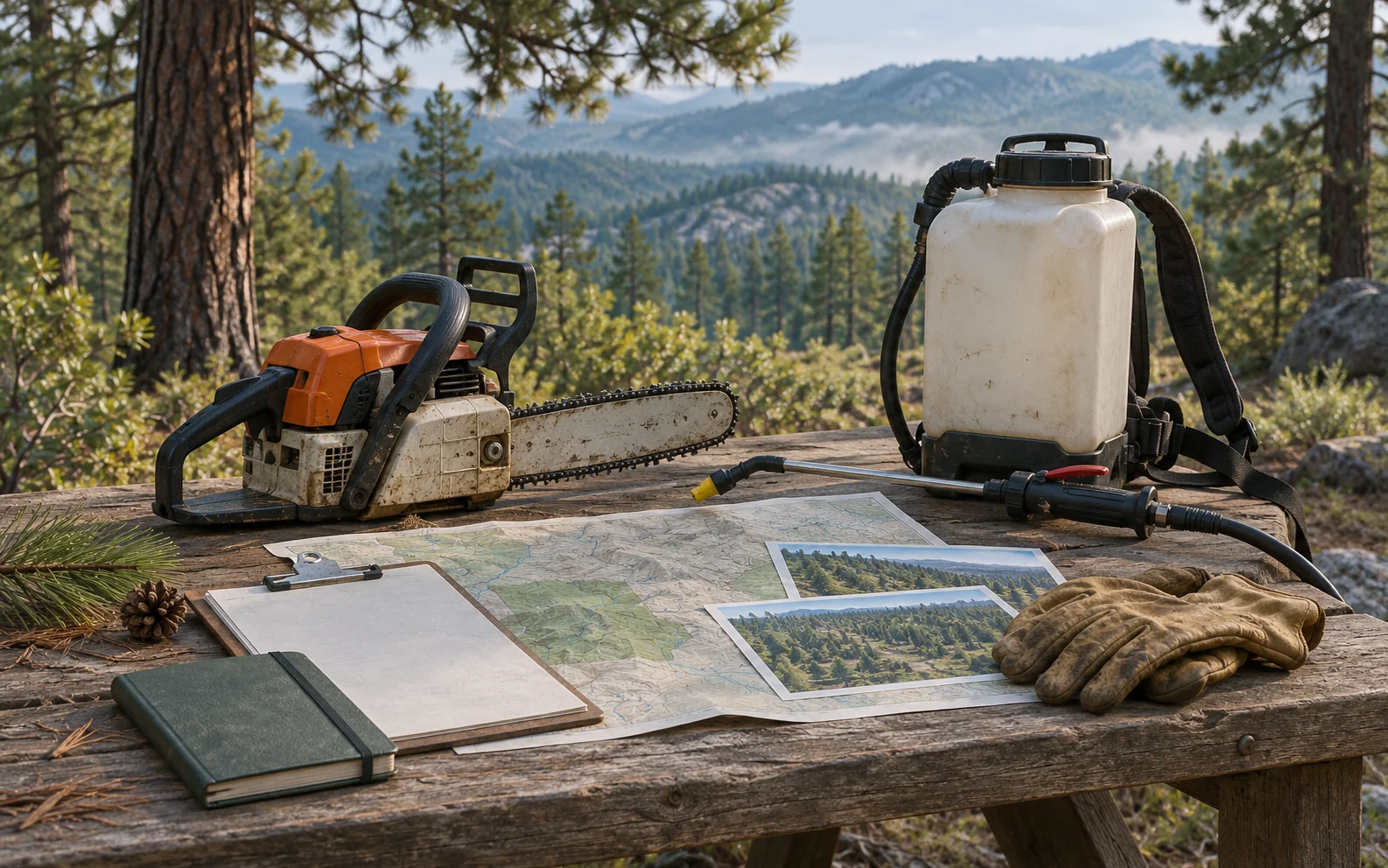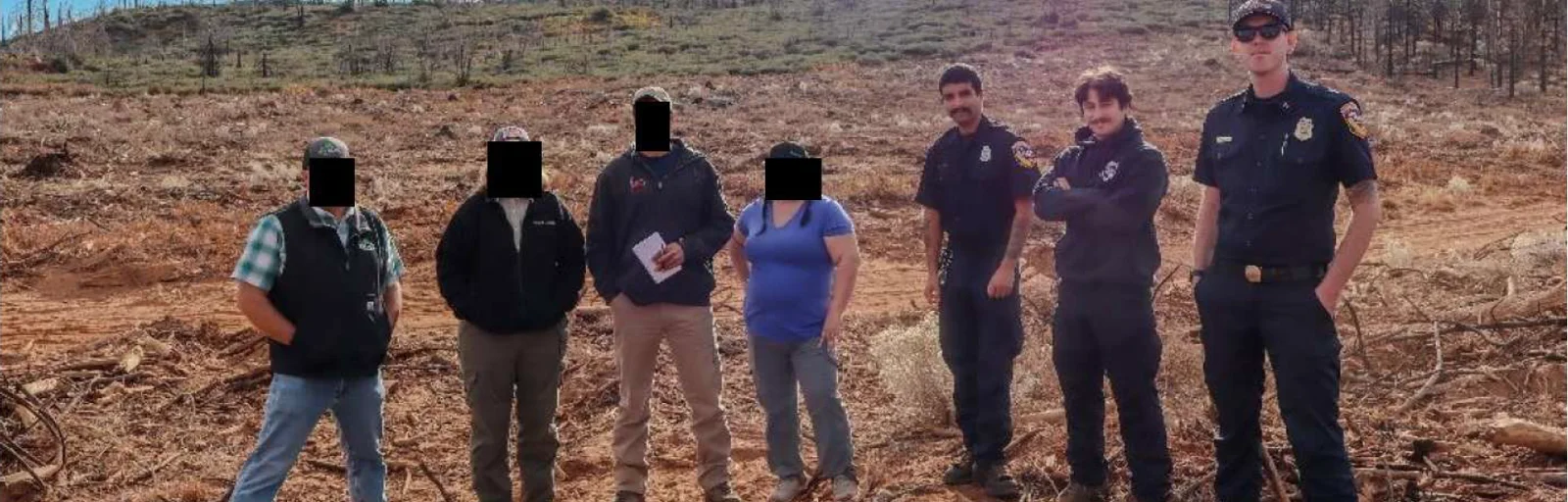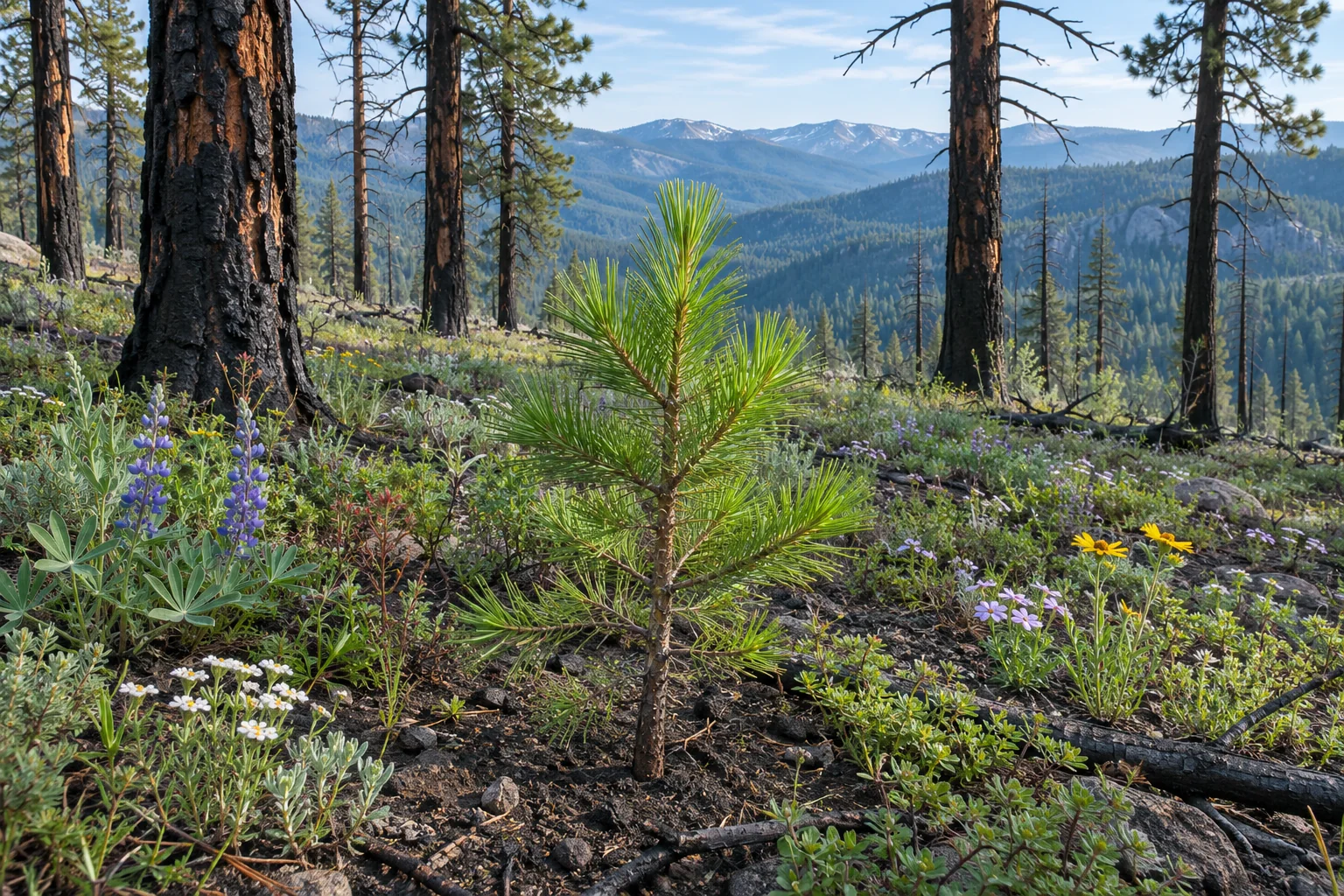
A young pine grows faster after nearby vegetation is removed. The result may be real, useful, and important. It still leaves a larger question unanswered: what happened to the rest of the forest?
Across Lassen and Plumas counties, the word restoration carries considerable weight. It can describe planting after fire, thinning living trees, treating shrubs, rebuilding habitat, or preparing a landscape for prescribed burning. Those activities can have different objectives and different consequences, even when they appear under the same heading in a project announcement.
A serious assessment should neither dismiss tree-growth research nor allow it to stand in for every other ecological outcome. The central issue is the claim being made. Evidence that helps explain how to establish conifers is not automatically evidence that a particular treatment improves water, wildlife habitat, future fire behavior, and long-term resilience.
There are real obstacles to bringing conifers back
A March 2026 UC Agriculture and Natural Resources factsheet explains why young trees can struggle after severe fire. Seed sources may be limited, growing conditions may be warmer and drier, and surrounding plants compete for resources, including soil moisture. Planting and vegetation management can improve establishment.
The guidance compares chemical treatment, grazing, manual removal, machinery, and prescribed fire. Their suitability and durability differ. A treatment that benefits seedlings can therefore be a defensible management choice; the relevant questions include where it is needed, which method fits the site, and how long the effect lasts.
The factsheet is guidance on reforestation and vegetation management. Reading it as a blanket demonstration that every herbicide application constitutes ecological restoration asks the source to answer a much broader question than its treatment comparisons establish.
This distinction also protects good projects from weak arguments. If the purpose is to establish a particular tree species in an area with few surviving seed sources, explain that purpose directly. It does not become more persuasive by attaching unmeasured benefits to the same treatment.
Climate and seed availability change the prospects
A 2023 study led by Kimberley Davis examined conifer regeneration across 10,230 plots associated with 334 western U.S. wildfires. The analysis covered eight widespread conifer species and found declining regeneration capacity over recent decades. Both severe fire, which can reduce seed availability, and post-fire climate affected recovery.
The researchers’ projections suggested that lower fire severity could help sustain regeneration in the near term, while increasingly warm and dry conditions would eventually outweigh that benefit in more places. The study identifies a limited opportunity for management to reduce the likelihood of forest loss.
It does not show that herbicide treatment is the necessary response on every burned acre. Nor does a regional projection establish the outcome for a particular hillside. Its contribution is to show why automatic assumptions about recovery—either that trees will always return or that intervention always works—are inadequate.
For a local project, the implication is a more specific starting point: identify the regeneration problem before selecting the remedy. Seed limitation, heat, drought, and competing vegetation are different constraints. Removing plants cannot substitute for a missing explanation of which constraint the work is intended to address.
The open stage after fire is still an ecosystem
Research by Mark Swanson and colleagues on early forest succession describes the ecological value of the period following disturbance, before a closed tree canopy develops. Surviving organisms, dead wood, herbs, and shrubs can create a structurally varied environment supporting complex biological communities. The authors warn that management can reduce the diversity and duration of these early stages.
This changes the meaning of a phrase such as “competing vegetation.” It describes a plant’s relationship to a selected tree or management objective. It does not describe everything that plant contributes to the recovering landscape.
Two observers can therefore look at the same shrub patch and identify different values. A forester may see an obstacle to conifer establishment. A habitat assessment may identify a component worth retaining. The decision is not resolved by choosing one label and treating the other function as nonexistent.
The practical issue is how much of each condition the project intends to maintain, and where. A restoration plan should be able to explain why it retains some open patches, encourages trees in others, and uses particular treatments around individual seedlings or across broader areas.
More trees do not always mean a better forest
A long-term Sierra Nevada study by Eric Knapp and colleagues offers a different caution. Researchers revisited mixed-conifer plots first measured in 1929. By 2007–08, tree density was about 2.4 times the original level, while large trees were underrepresented and shrub cover had fallen sharply.
The density of smaller and intermediate trees was similar in contemporary logged and unlogged areas, suggesting that prolonged fire exclusion mattered more to that pattern than the historical logging treatment. The researchers concluded that thinning or prescribed fire that increased light could benefit understory vegetation.
This was a study of particular central Sierra Nevada stands, not a prescription for every forest in Lassen or Plumas. Its relevance is that a rising tree count can accompany a loss of other desirable characteristics. Counting stems alone would have missed much of the change.
That finding complicates a simplistic opposition between tree removal and ecological care. Depending on the starting condition and treatment design, removing some trees may help restore features that dense growth has displaced. The justification has to come from those conditions and outcomes, not from the word thinning itself.
Growth can support resilience without defining it
In a 2022 analysis of frequent-fire western forests, Malcolm North and colleagues compared historical and contemporary conditions using a measure of competition among trees. They argued that low historical densities supported vigorous growth and that substantial density reductions may be needed to rebuild resilience in some of these forests.
The study is important precisely because it connects growth to a specified ecological setting: forests shaped by frequent fire, with contemporary competition and stress. It does not establish that maximizing the number of planted trees or the volume of a future timber harvest produces the same result.
Protect Lassen’s interpretation is that growth belongs in an assessment of forest condition, but the surrounding assumptions must remain visible. Which trees are growing? At what density? What other vegetation remains? Does the proposed future resemble a varied forest adapted to the site, or primarily a production target?
Economic objectives can be stated honestly alongside ecological ones. Timber production, rural employment, habitat, and watershed protection can all matter to a community. They do not become interchangeable merely because a project has several stated purposes.
Compare the complete treatment, over a meaningful period
A first-year survival count is evidence about the first year. A photograph of green seedlings is evidence that seedlings were present when the photograph was taken. Neither establishes what the site will look like after later drought, regrowth, maintenance, or fire.
Consider a hypothetical planting project with excellent initial survival but a continuing need for vegetation treatment. The survival result should be reported. So should the recurring work, its cost, and its effects. If a different approach produces slower early growth with fewer later interventions, the comparison should include that trajectory as well.
Likewise, the relevant alternative is not always doing nothing. It may be planting at a different density, retaining more naturally established trees, treating smaller areas, or using another vegetation method. These are alternatives to evaluate, not claims that any one will outperform the others on every site.
| Outcome | Evidence that would make the claim meaningful |
|---|---|
| Tree establishment | Survival and growth by species, including natural regeneration and the starting conditions. |
| Habitat | Changes in shrubs, herbs, dead wood, canopy structure, and the organisms the project is intended to support. |
| Soil and water | Ground condition and relevant measurements before and after the complete treatment sequence. |
| Durability | Repeat treatments, maintenance costs, and results over several growing seasons. |
What restoration should have to demonstrate
These proposed measures do not require every project to produce every possible benefit. They require the stated benefit to match the evidence. A project can succeed at establishing trees while leaving an unresolved question about water. Another can improve habitat without maximizing merchantable growth. Honest reporting makes those differences understandable.
For Lassen and Plumas, the strongest standard is neither automatic intervention nor automatic nonintervention. It is a clear account of the condition being addressed, the alternatives considered, and the ecological results actually measured.
Growing trees faster can be part of restoring a forest. Calling it restoration should require an explanation of the forest those trees are helping to create.
Related: Does salvage logging help recovery? and Genesee’s proposed grazing alternative.