
Jason Ingram’s Fire Insurance Hypocrisy: How Lassen County’s Supervisor Fuels the Crisis He Claims to Fight
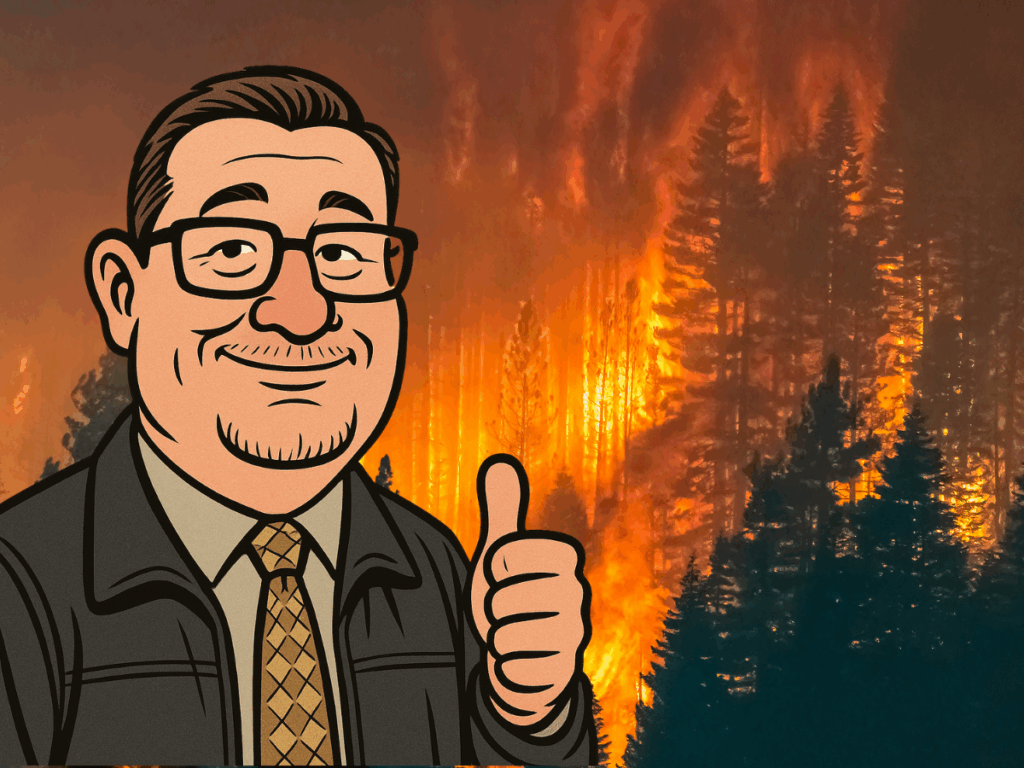
Table of Contents
Lassen County District 5 Supervisor Jason Ingram has positioned himself as a champion for wildfire insurance reform, publicly demanding action from California’s Insurance Commissioner. But a closer look at Ingram’s record reveals a troubling contradiction: while he condemns rising fire insurance costs, he continues supporting the exact policies that make wildfires worse.
Jason Ingram’s Public Demands for Insurance Reform
In August 2023, Jason Ingram made headlines with his passionate plea for insurance relief. The Lassen County supervisor highlighted devastating impacts across Northern California:
- Senior citizens forced from their homes due to unaffordable premiums
- Mass population exodus from Lassen, Modoc, Plumas, Siskiyou, and Mono counties
- Former Susanville Fire Chief paying $850 monthly for fire insurance
- Urgent need for bipartisan solutions to protect vulnerable homeowners
Ingram’s concerns sound reasonable—until you examine what he’s actually doing in Lassen County.
How Jason Ingram Enables Fire-Prone Forestry Practices
While Ingram demands state intervention, his own county enables projects that increase wildfire risk through the Honey Lake Resource Conservation District. The Honey Lake Valley Resource Conservation District (HLVRCD) is a special district of the state of California, but operates as a quasi-county agency with deep ties to local government. Under California law, Resource Conservation Districts are “legal subdivisions of the state” that function as special districts—a form of local government created to meet specific community needs. RCDs can be formed through a resolution of the County Board of Supervisors, and their boards are locally appointed or elected, making them closely connected to county leadership while maintaining independence.
This structure allows Lassen County to facilitate massive forestry projects through HLVRCD using Cal Fire taxpayer money and grants funneled through the Honey Lake RCD, or sometimes Cal Fire grants paid directly to industrial logging companies like W.M. Beaty & Associates. The county can claim these aren’t technically “county projects” even though the projects proceed through their jurisdiction without meaningful oversight. It’s a convenient arrangement that lets supervisors like Ingram avoid direct accountability for fire-prone land use decisions while allowing state and federal grant money to flow to industrial forestry operations that bypass normal county review processes.
The Lassen County Board of Supervisors established the Honey Lake Valley Resource Conservation District in 1954 through Resolution #394, giving the county significant influence over the organization that now facilitates these controversial projects. While the RCD operates with “locally appointed or elected” board members and maintains nominal independence, the supervisors aren’t passive bystanders—they’re actively involved with the organization that enables fire-prone forestry practices across thousands of acres.
Industrial Tree Plantations
Under Ingram’s supervision, Lassen County allows these massive projects to continue every year without intervention or oversight:
- Monoculture conifer plantations that create highly flammable forests
- Dense, same-aged tree stands that burn faster and hotter than natural forests
- Water-intensive plantation trees that dry out surrounding landscapes
This includes not only projects funded through the Honey Lake RCD, but also direct CAL FIRE grants to logging companies and massive acreage of private industrial forestry operations that the supervisors let go unchecked without meaningful oversight or environmental review.
Chemical Site Preparation
The county supports herbicide-based vegetation removal that:
- Eliminates diverse, fire-resilient native plants
- Creates uniform plantations prone to rapid fire spread
- Removes natural fire breaks and ecological buffers
Lack of Oversight
Most troubling, Ingram and the Lassen County Board allow these massive industrial operations to bypass:
- Formal zoning review processes
- Public scrutiny and input
- Environmental accountability measures
- Basic land use consistency checks
Even more damning, Ingram and his fellow supervisors have direct control over land use and zoning throughout Lassen County. They have the authority to regulate, restrict, or prohibit the very industrial forestry practices that are driving up fire insurance costs. Yet they choose to allow these fire-prone projects to proceed unchecked while simultaneously funding them through the RCD. This isn’t oversight—it’s complicity.
Adding to their pattern of avoiding accountability, the county board and County Administrative Officer Maurice Anderson employ attorney Michelle Naisse to ensure that herbicide documentation is not released to the public—despite these being public records. The Board of Supervisors is actively hiding information from the very constituents they claim to serve, using taxpayer-funded legal maneuvering to keep citizens in the dark about the chemical treatments being applied across their landscape.
Why Insurers Are Watching Jason Ingram’s County
Modern insurance companies use satellite imagery and AI modeling to assess risk. What they see in Lassen County:
- Expanding clearcuts across hillsides
- Dense monocultures with no fire breaks
- Industrial reforestation creating fire-prone landscapes
- Minimal environmental regulation or oversight
These patterns aren’t insurance-friendly—they’re red flags for elevated wildfire risk.
Jason Ingram Can’t Have It Both Ways
Ingram warns: “We’re going to end up with a bunch of vacant homes that cannot be sold.”
Yet he promotes the very land practices pushing those homes into uninsurable fire risk categories. The supervisor knows exactly what’s happening in Lassen County’s forests, including the industrial reforestation his county funds.
Ingram demands: “I want Ricardo Lara to come here and tell us what he’s doing.”
But the District 5 supervisor should first explain what he’s doing to stop industrial landowners from turning Lassen County into a fire trap. Ironically, Ingram is demanding accountability from California Insurance Commissioner Ricardo Lara—the state official who oversees the nation’s largest insurance marketplace—while Lara himself has faced criticism for missing nearly all key Senate Insurance Committee hearings since 2019, often due to extensive taxpayer-funded travel, even as the insurance crisis has worsened under his watch.
More troubling still, Ingram is placing blame on the state insurance commissioner when he and the other Lassen County supervisors have all the power they need to fix the issue right here at home. They control local zoning, land use approvals, and environmental oversight—yet they purposely ignore these tools and refuse to address the fire-prone forestry practices they’re enabling.
The money trail reveals the scope of the problem: CAL FIRE provides grants directly to companies like W.M. Beaty & Associates, which has received millions in taxpayer funding over the years. Sometimes the money flows through the Honey Lake RCD to the Lassen Fire Safe Council, which then hires the same industrial timber companies as subcontractors. Either way, public dollars fund “fire prevention” projects that often recreate the same plantation conditions that made areas burn severely in the first place.
Instead of using their authority to regulate these problematic practices, the supervisors deflect responsibility to Sacramento while making the crisis worse.
What Jason Ingram Must Do If He’s Serious About Reform
For Ingram to credibly fight the insurance crisis, he must:
- Acknowledge the land use connection – Stop pretending insurance problems exist in a vacuum
- End fire-prone reforestation funding – Recognize that herbicide-based conifer plantations accelerate wildfire risk
- Implement proper oversight – Require meaningful zoning review for industrial forestry projects
- Support ecological alternatives – Promote forestry models that actually reduce fire risk
Jason Ingram’s Pattern of Ignoring Accountability
For months, Protect Lassen has sent emails to Ingram and the entire Lassen County Board of Supervisors detailing these concerns. The supervisor ignored every message. This article was sent to Ingram prior to publication, offering him a chance to clarify his position.
Ingram chose silence.
The other supervisors—Mike Scanlan, Gary Bridges, Tom Neely, and Aaron Albaugh—also received formal notice, along with County Administrative Officer Maurice Anderson and Planning Director Gaylon F. Norwood. Not one responded to months of attempts to engage them on this critical issue affecting their constituents’ insurance costs and community safety.
They refuse to address this issue, and clearly for good reason—acknowledging the problems would require them to confront their own role in perpetuating practices that are driving up insurance costs while enriching the timber companies they enable.
The Bottom Line on Jason Ingram’s Fire Insurance Theater
Has anything changed for the better since Ingram started calling for fire insurance reform? No—it has only gotten worse because he refuses to address the real issue. While he grandstands about state-level solutions, the underlying problem of fire-prone land use practices continues unchecked in his own jurisdiction.
Ingram’s public outrage is performance politics—calculated displays meant to pacify constituents while avoiding real solutions. You can’t fight fire insurance risk while funding the fire.
The supervisor and his colleagues continue enabling the exact industrial forestry practices that insurers have flagged as uninsurable. His county funds projects that recreate the same plantation forests that have repeatedly burned across California.
What Lassen County Residents Must Know About Jason Ingram
Ingram’s approach represents everything wrong with local politics: deflection, contradiction, and complicity. While he demands state action on insurance, he refuses to address his county’s role in creating the problem.
The people of Lassen County deserve better than this kind of sleight of hand. If we want meaningful change on fire insurance, we need leaders who will acknowledge—not perpetuate—the root causes of wildfire risk.
Jason Ingram has shown his true priorities. It’s time for voters to show theirs.
Links:
The Real Reason Your Home Insurance is Rising in Lassen County, CA