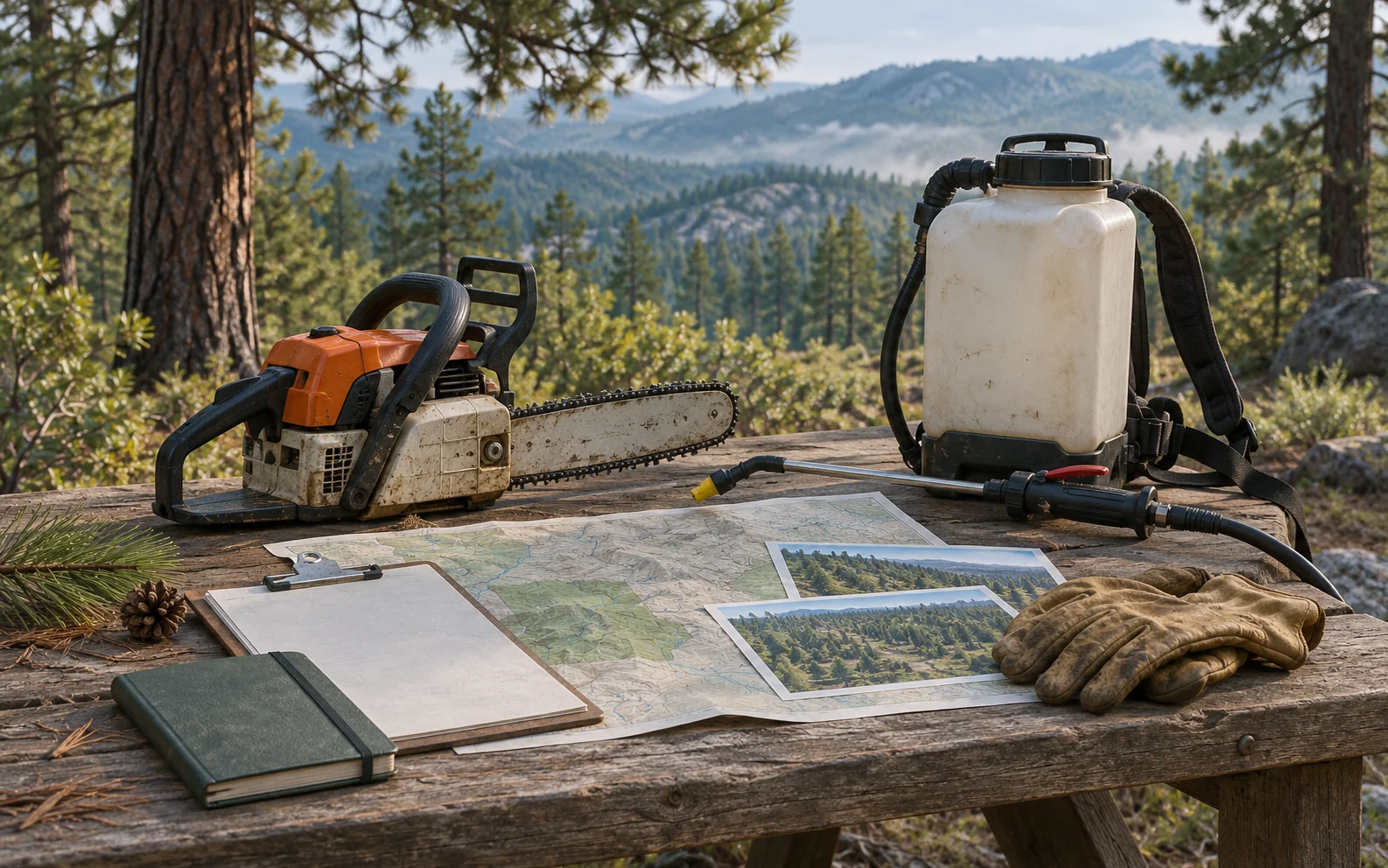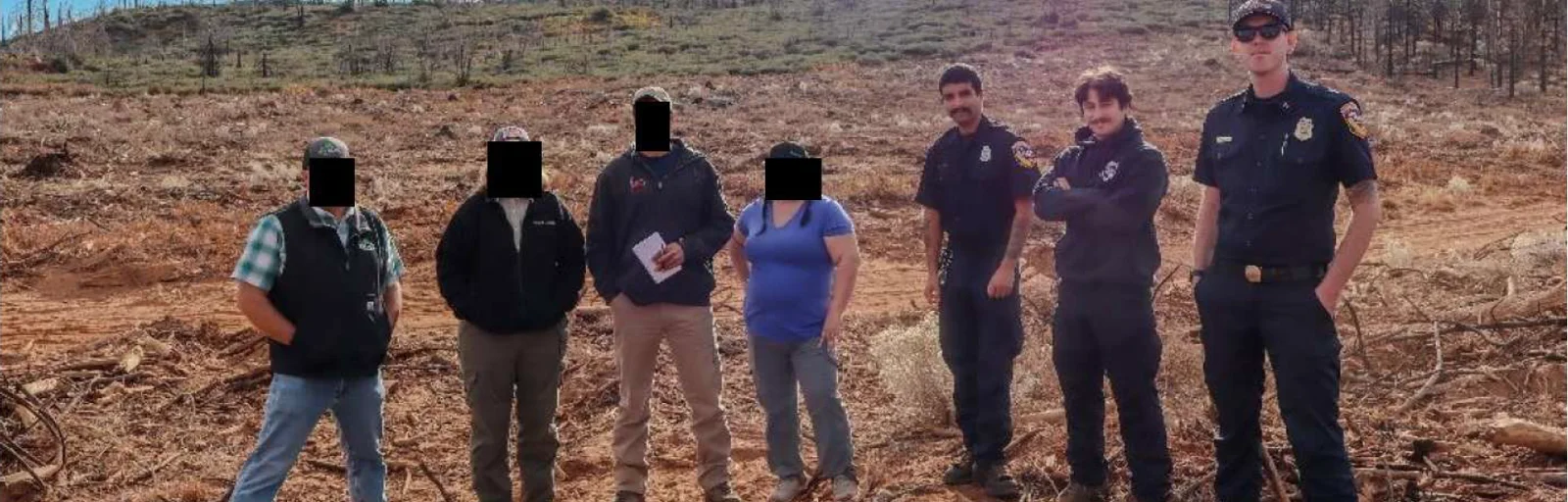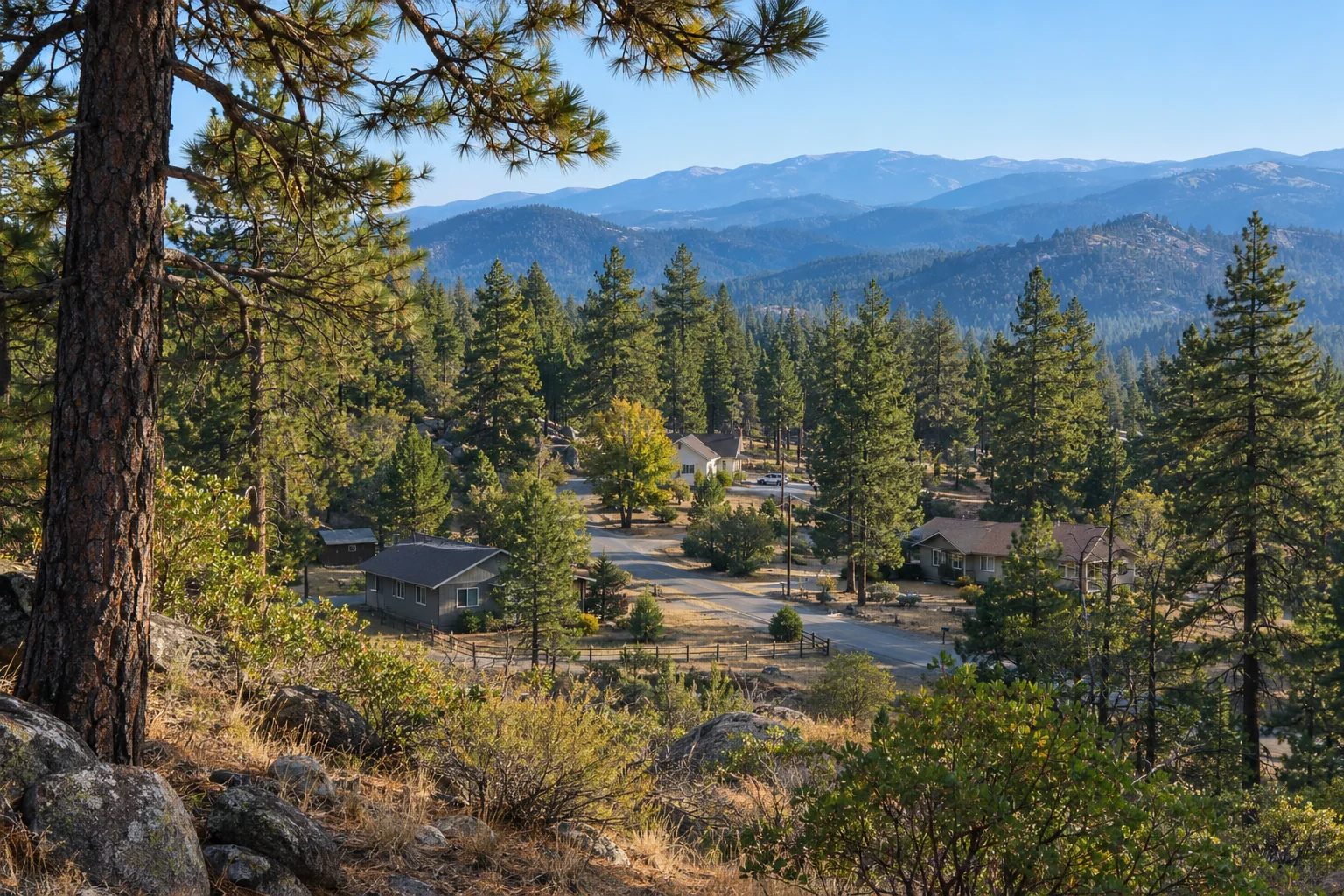
Plumas National Forest’s Community Protection project brings several different kinds of work under one name: cutting trees, treating brush, burning vegetation, and using herbicides. For nearby residents, the important issue is which of those activities will happen on which ground.
A project-wide approval is not a schedule for every treatment. A thinning contract does not establish that herbicides will be applied to the same acres. And a statement that no chemicals are included in one season’s contracts does not remove chemical treatment from the broader plan.
Understanding those distinctions is essential to following an effort that affects communities, recreation areas, and watersheds across the northern Sierra. The public debate is about both the stated goal of reducing wildfire risk and the means chosen to pursue it.
Which project—and which communities?
The Forest Service’s official project listing identifies Community Protection–Central and West Slope as project 62873. It encompasses Greater American Valley, Greater Mohawk Valley, and West Slope communities, with affected locations in Butte, Plumas, Sierra, and Yuba counties.
The listing records a first decision for La Porte and Greater Mohawk Valley in September 2023 and a second decision dated July 1, 2025. Its planning status is marked completed. That status should not be read as a claim that every field operation has finished; it describes the agency’s project-planning record.
The project’s name can also be confused with the broader Plumas Community Protection funding landscape. An individual environmental-review boundary, a funding initiative, and a contractor’s assigned acreage are different units. The acreage and date attached to each should travel with the claim.
For a resident, the most useful reference point is the treatment area near a road, neighborhood, trail, or water source—not simply the total acres in a regional announcement.
Herbicides are one part of the treatment plan
The Forest Service’s 2024 public description of the draft plan included manual and mechanical work, prescribed fire, herbicide application, and reforestation. Those are distinct operations with different purposes. Removing small trees, preparing a planting area, treating selected plants, and burning accumulated material should not be described as though they are the same action.
The Mountain Messenger’s account of the June 2025 environmental assessment described a roughly 218,000-acre project with potential herbicide treatment on up to 51,000 acres. It identified seven proposed active ingredients: aminopyralid, chlorsulfuron, clopyralid, fluazifop, imazapyr, triclopyr, and glyphosate.
The report described hand application or vehicle-mounted spraying for vegetation control and reforestation preparation. It also reported that particular chemical choices and quantities were not assigned to individual locations in that broad description. These figures characterize the reported plan; they are not measured acres sprayed or amounts already applied.
In the same report, Forest Service spokesperson Tamara Schmidt described multidisciplinary review before herbicide use and said access-point notices identify products, application dates, and restricted-entry periods. Those agency assurances describe its stated process. They do not replace site-specific information about an actual operation.
Ground application still deserves a complete explanation
The distinction between ground and aerial methods matters, particularly in a region where public concern often centers on helicopters. But identifying the application equipment is only the beginning of an exposure discussion.
Our explainer on drift and runoff examines why airborne movement during application and later movement with water are separate questions. A project should explain both the application method and the conditions under which the selected product could leave the treatment area.
For example, a statement about preventing spray droplets from crossing a boundary does not, by itself, describe what will happen during a later storm. Conversely, a hypothetical runoff concern is not proof that a particular application has contaminated a stream. The chemical, location, timing, and measurements determine how far a conclusion can go.
That is why a meaningful public description needs more than “herbicides may be used.” It should identify the target vegetation, treatment area, selected product, expected timing, and protections relevant to nearby land and water. Without those details, people are being asked to assess a category of activity rather than the operation that could affect them.
Plumas County asked that chemicals be a last resort
An April 1, 2025 county planning memorandum records Plumas County’s objections and a March meeting with the Forest Service. The county acknowledged that herbicides might sometimes be needed, but urged other methods first, including grazing, and recommended chemical treatment only as a last resort.
The county also sought water-quality monitoring and protection for sensitive areas and nontarget organisms. Those recommendations are a local policy position, not a federal ban or proof that all requested measures became binding project conditions.
There is an important implementation question behind that distinction. “Consider alternatives” can mean very different things depending on whether alternatives are evaluated for each site, discussed once at the planning stage, or tied to an enforceable decision rule. A claim that chemicals are a last resort should explain the actual threshold for selecting them.
Genesee residents’ proposed grazing and prescribed-fire pilot offers one local example of an alternative being developed. Its potential relevance does not establish that it could replace every chemical treatment in the much larger Community Protection area.
Road access and steep slopes shape the available work
A March 2025 Forest Service research assessment of mechanical-treatment constraints examined how slope, distance from roads, and stream-buffer assumptions affect the acreage available for machinery within the Plumas landscape.
Its scenarios changed assumptions about access and operating limits. This is a planning analysis, not a separate authorization to change a stream buffer or operate equipment on any particular slope. The distinction matters: an analyst can compare several hypothetical conditions without granting permission to implement them.
The report helps explain why treatment methods differ across a landscape. A site accessible to equipment presents a different operating problem from steep or remote ground. That does not establish that herbicides are the only alternative on the latter. It means the choice must account for real constraints instead of assuming one method can be applied uniformly.
Public comparisons should preserve those constraints. Comparing a machine treatment on accessible ground with hand work on a steep hillside, without acknowledging the difference, can make the more expensive option look inefficient for reasons unrelated to its performance.
What current contracts do—and do not—show
The Plumas Sun’s June 2026 report on a Portola City Council update described National Forest Foundation representatives discussing four mechanical-treatment contracts for that year without herbicides in those contracts. That was information about identified work, not a promise that all future Community Protection treatments would exclude chemicals.
A newer Foundation solicitation for McKinsie seeks hand thinning and piling across 1,863 acres west of Whitehawk Ranch. With bids due November 30, 2026, it provides a specific example of work moving toward contracting. Its stated scope is hand thinning and piling; it should not be characterized as a herbicide contract.
These examples show why the project deserves coverage at two levels. The broad decision establishes available actions and conditions. Individual contracts reveal what a particular implementing organization is asking crews to do at a particular stage.
Neither level replaces the other. Reporting only the broad plan can make every permitted activity sound imminent. Reporting only a nonchemical contract can conceal the fact that chemical treatment remains possible elsewhere or later.
The dispute is about the methods as well as the goal
In a June 2026 statement, Feather River Action and allied groups called for a halt to forest herbicide spraying and challenged the Forest Service’s approach. Their statement documents the organizations’ position. Its broader allegations should not be confused with findings by a court or with measurements from a completed local monitoring program.
The presence of opposition does not resolve the scientific questions. Neither does the agency’s use of the words restoration or community protection. Both supporters and critics should be able to connect their claims to the operation being discussed and the evidence relevant to it.
The public interest is especially clear where benefits and burdens fall in different places. A project may promise a regional reduction in fire risk while concentrating particular operations near a community or water source. A regional objective does not eliminate the need to explain the local effects.
What should count as progress?
Protect Lassen’s standard would track progress by treatment unit and by stage: work authorized, contracted, started, finished, and evaluated. It would identify which operations were performed and what follow-up remains. If thinning is intended to prepare for prescribed burning, the account should show whether the burn happened.
For herbicide work, the equivalent account would distinguish the acres considered eligible from the acres actually treated, identify the products used, and present relevant monitoring results. The absence of measurements should remain an information gap rather than being converted into either proof of harm or proof that no offsite movement occurred.
The same discipline belongs in the financial coverage. An allocation to a partner, a contract ceiling, and a payment for accepted work are different milestones. Our report on Plumas restoration funding follows several of those connections.
For communities around Plumas National Forest, the test is what happens on the ground. The size of the plan makes clear explanations more necessary, not less. Residents should be able to understand what work is planned near them, why that method was selected, and what the results show after the crews leave.
Status reviewed November 16, 2026. The 2025 acreage and chemical list above are attributed to the Mountain Messenger’s account of the environmental assessment; they are not a tally of completed applications. Individual contract scopes are identified separately.