

The Hidden Cost of Lumber: A History of Timber Industry Pollution in California
California’s vast forests have long been at the center of its economic engine and environmental identity. Towering redwoods, lush conifer stands, and sprawling oak woodlands once covered large portions of the state. But over more than 150 years of aggressive logging and chemical-based forestry, the timber industry has left behind a trail of ecological damage—one marked by habitat loss, water pollution, and a complex web of regulatory loopholes.
I. Logging Boom and Early Ecological Impact
The modern timber industry in California traces its roots to the mid-19th century. As settlers surged westward during the Gold Rush, so did demand for lumber to build cities, mines, and railroads. Logging operations spread across the Sierra Nevada, Klamath Mountains, and coastal redwood regions.
Redwood forests, in particular, were devastated. By the 1950s, an estimated 95% of the original old-growth redwoods had been logged in California (Redwood National and State Parks, NPS.gov). Clearcutting—felling all trees in a given area—was standard practice. With no replanting or erosion control, hillsides collapsed, rivers clogged with sediment, and wildlife populations plummeted.
Aquatic ecosystems suffered particularly harsh consequences. The California Department of Fish and Wildlife has noted that logging-induced erosion was a major factor in the decline of salmon and steelhead trout across Northern California rivers (CDFW, “Fish Habitat Impacts from Logging”).
II. Plantation Forestry and the Herbicide Era
By the mid-20th century, old-growth timber was largely depleted. To maintain yields, companies shifted to plantation forestry: clearcutting large tracts and replanting them with uniform, fast-growing species like Douglas fir and ponderosa pine.
These plantations suppressed natural biodiversity. Native hardwoods, shrubs, and groundcover were considered “competition” and eliminated through chemical means. Herbicides such as 2,4-D (an ingredient in Agent Orange), hexazinone, triclopyr, and atrazine became industry standards.
According to a 2009 U.S. Forest Service report, herbicides were applied to hundreds of thousands of acres of private and public timberland annually in California. These chemicals were delivered aerially via helicopters—often drifting into creeks, farms, and neighboring properties.
Health concerns were mounting. In a 1984 study published in Environmental Health Perspectives, researchers documented increased miscarriage rates and birth defects in rural populations exposed to 2,4-D. More recently, the International Agency for Research on Cancer (IARC) classified glyphosate—a commonly used timberland herbicide—as “probably carcinogenic to humans” (IARC, 2015).
Despite such risks, residents living near sprayed areas were rarely notified. Chemical application records were filed—if at all—only with county agricultural departments. No independent monitoring was conducted.
III. Water Contamination and Rural Exposure
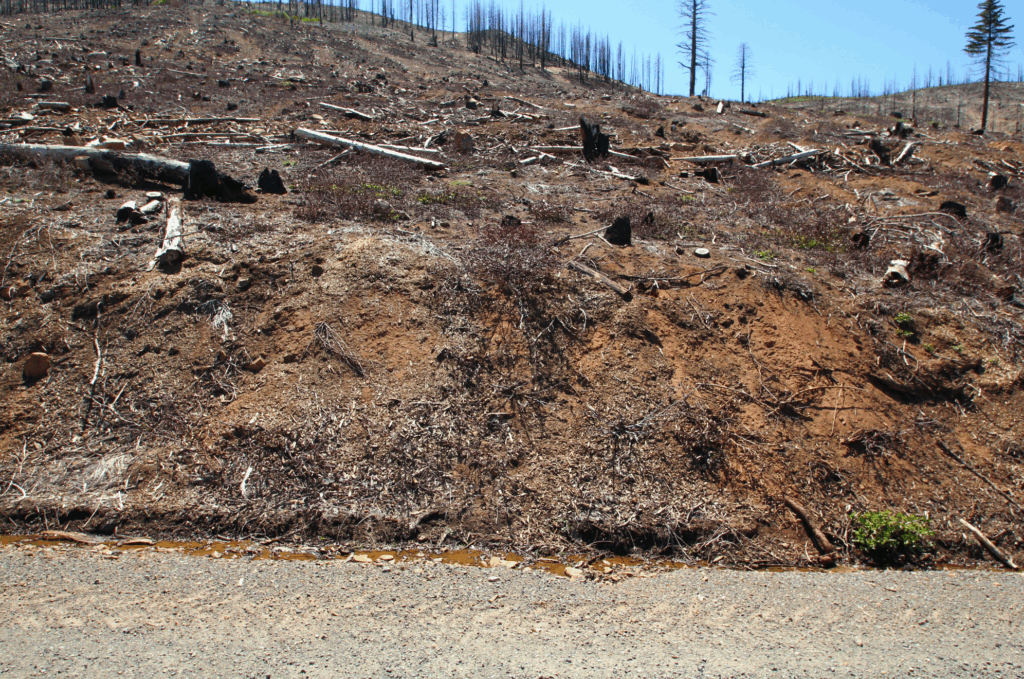
In California’s timber country, many residents rely on well water and surface springs. These water sources often lie downhill from sprayed logging sites, making them vulnerable to runoff and drift.
Yet no statewide system exists to monitor rural drinking water for herbicide residues. The California State Water Resources Control Board oversees the Groundwater Ambient Monitoring and Assessment (GAMA) Program, which offers regional assessments of groundwater quality—but testing is voluntary, and the program does not mandate regular herbicide testing for private wells. As a result, monitoring of chemical contamination from forestry operations is inconsistent at best.
Similarly, the California Department of Pesticide Regulation (DPR) runs a groundwater protection program focused on agricultural pesticide contamination. However, this program targets areas with known or suspected contamination and does not provide routine statewide testing for herbicides in domestic wells, especially in timber regions.
Because of this oversight gap, detection of chemical contamination often falls on rural residents themselves. Well owners are encouraged—but not required—to test their water, and in many cases, communities have had to pay for their own lab testing or pursue lawsuits to uncover the presence of forestry-related herbicides in drinking water.
This system places the burden of proof—and cost—on the most vulnerable populations. Without mandatory testing or public health monitoring, rural residents are often left to wonder whether their water is safe to drink.
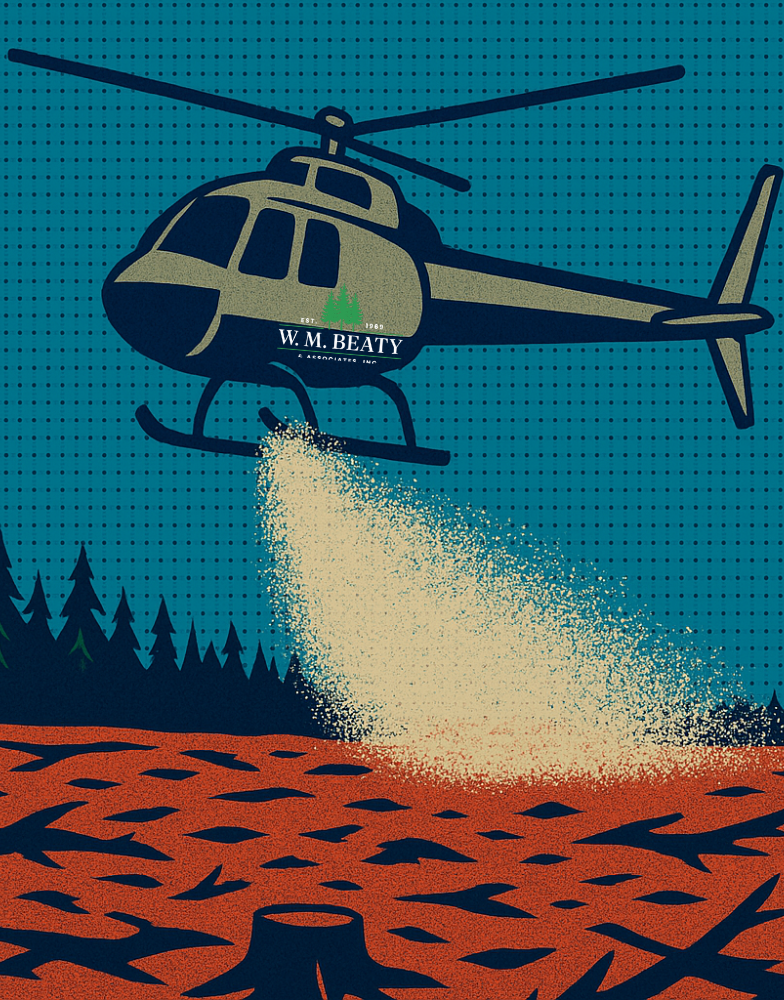
This image is an editorial illustration based on direct eyewitness observation and official pesticide use records confirming that W.M. Beaty & Associates, Inc. authorized the aerial application of herbicides across thousands of acres in Lassen County, California.
Aerial spraying was conducted by the licensed contractor:
Western Helicopter Services
Phone: (503) 538-9469
License #: 30717 (Pest Control Business)
This contractor is listed on Restricted Materials Permit #18-20-4500033 issued by the Lassen County Department of Agriculture.
Confirmed herbicides applied include:
2,4-D, glyphosate, triclopyr, hexazinone, imazapyr, and clopyralid — all used in large-scale industrial timber operations across clearcuts and post-fire landscapes. These chemicals were sprayed by helicopter near forested watersheds, and rural homes without any public notification, to our knowledge. One eyewitness reported watching a helicopter fly low and repeatedly over the edge of his property in the early morning hours, while approximately 3,724 acres were sprayed in the Diamond Mountains near Gold Run Road. He received no warning from W.M. Beaty & Associates, the County of Lassen, or any regulatory agency.
This image reflects public concern over toxic exposure, environmental health risks, and the failure of California’s regulatory agencies to protect rural communities from unmonitored pesticide use.
IV. Regulatory Loopholes and Industry Self-Monitoring
California’s timber regulations are split between multiple agencies—none of which is tasked with comprehensive oversight of chemical use. The California Department of Forestry and Fire Protection (CAL FIRE) approves Timber Harvest Plans (THPs), which outline logging activities but often defer herbicide oversight to the Department of Pesticide Regulation (DPR).
The DPR, in turn, relies on counties to track herbicide application and incidents. But enforcement is weak. In a 2019 audit by the California State Auditor, multiple counties failed to inspect pesticide applicators or follow up on public complaints.
Timber companies often sidestep California’s Environmental Quality Act (CEQA) by filing a “Notice of Exemption,” claiming that reforestation or fuel reduction poses no significant environmental impact. This allows massive clearcutting and chemical spraying projects to proceed with little to no public input or ecological review.
Meanwhile, grant funding from state and federal agencies flows freely to timber operators under the guise of “forest health” or “wildfire recovery.” Much of this money—through CAL FIRE, the Sierra Nevada Conservancy, or Federal Emergency Management Agency (FEMA) disaster grants—is used to subsidize spraying and replanting programs that replicate the very conditions that led to environmental degradation.
V. Documented Cases and Public Backlash
In the 1990s and early 2000s, lawsuits and investigative journalism began exposing the darker side of timberland management. In Humboldt County, tribal governments and environmental groups documented severe sedimentation and chemical drift in salmon-bearing streams. In Mendocino, whistleblowers revealed that companies internally tracked herbicide complaints but avoided regulatory reporting.
One of the most troubling revelations came from a leaked 2003 memo by a timber executive in Shasta County, which read: “We’re not required to notify adjacent landowners, and the fewer questions, the better.” This memo became a flashpoint for advocates calling for public notification of spraying activities.
Despite growing awareness, state agencies have been slow to act. Many county agricultural commissioners—who are responsible for pesticide oversight—lack the staffing, expertise, or willingness to confront large timber operators.
Meanwhile, rural residents, especially in remote or economically dependent counties, face intimidation or ostracism for speaking out.
VI. Wildfire Recovery and the Herbicide Feedback Loop
In recent decades, California’s worsening wildfire seasons have introduced a new justification for old practices: “reforestation.” After large wildfires like the Dixie Fire (2021) or Camp Fire (2018), timber companies rapidly seek permits and grants to clear burned trees and replant monoculture forests.
These post-fire replanting projects often include aerial herbicide applications to control vegetation regrowth, particularly in federal or private timberlands. The theory is that fast-growing conifers will replace natural regeneration and reduce fire fuel—yet many scientists argue the opposite.
A 2021 peer-reviewed study in Ecological Applications found that reforested plantation sites may burn more intensely and more frequently than natural forests, especially when herbicide use suppresses broadleaf and native species that hold more moisture and slow fire spread.
These projects are frequently exempted from CEQA review. There is little transparency on which chemicals are used, how often, and what ecological monitoring—if any—is performed afterward.
VII. Moving Forward
The timber industry’s environmental legacy in California is vast, under-reported, and still unfolding. Generations of clearcutting, chemical spraying, and regulatory evasion have reshaped the state’s forests and waterways. While the public narrative focuses on jobs, fuel reduction, and wildfire response, the hidden costs—poisoned wells, collapsing salmon populations, contaminated soil—continue to mount.
To this day, no state agency systematically tracks herbicide exposure on timberland. Residents must bear the burden of proof, often at great personal cost, simply to know what chemicals were sprayed near their homes.
As climate change intensifies wildfire risks, the pressure to act quickly is understandable. But “forest recovery” cannot be an excuse for more ecological harm. True recovery requires science-based practices, community involvement, and accountability. Until then, California’s timberlands will remain not just a resource, but a battleground.
Sources:
- National Park Service – Redwood Logging History
- California Department of Fish and Wildlife – Logging and Fish Habitat
- IARC Monograph 112: Evaluation of Glyphosate (2015)
- U.S. Forest Service – Herbicide Use in Reforestation (2009)
- Environmental Health Perspectives – 2,4-D Health Effects Study (1984)
- California State Auditor Report on Pesticide Oversight (2019)
- Ecological Applications – Post-Fire Plantation Fire Behavior Study (2021)
- Environmental Management – Silviculture and Herbicide Runoff (2014)
- California State Water Resources Control Board – GAMA Program Overview
- California Department of Pesticide Regulation – Groundwater Protection Program